Supply Chain Resilience in Indonesian Ceramic Tiles Manufacturing: A President Director’s Perspective
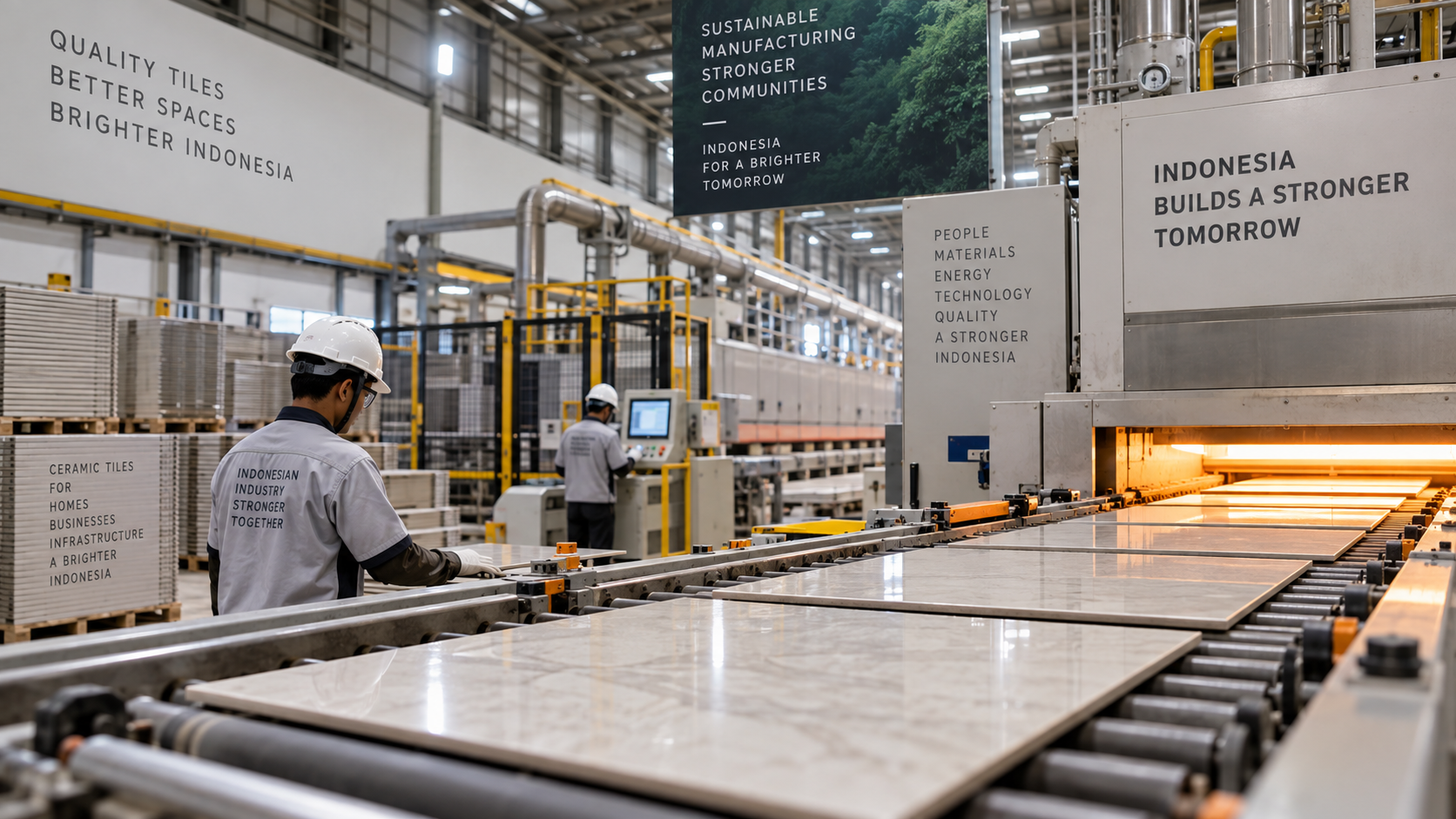
A ceramic tile is the visible end-product of a much larger industrial system.
Before a tile reaches a distributor, project site or home, mineral inputs must be mined, processed, blended and transported. Gas must reach the factory at sufficient volume and pressure. Mills, presses, dryers, kilns, glazing lines and sorting equipment must remain operational. Finished products must then move through warehouses and logistics networks across Indonesia's archipelagic market.
For a president director, supply-chain resilience is therefore not a procurement project. It is an operating system connecting geology, raw-material science, energy, manufacturing, logistics, finance, commercial planning, technology and governance.
In ceramic tile manufacturing, three supply chains deserve particular attention:
1. Ball clay, which supports plasticity, workability and green strength.
2. Feldspar, which acts as a flux and influences vitrification, firing behaviour, strength and energy consumption.
3. Natural gas, which is not merely another purchased input but the thermal foundation of continuous kiln operations.
These three inputs behave differently. Ball clay and feldspar can be stockpiled, blended and potentially secured through upstream investment. Gas cannot be stored economically at factory scale in the same way, and interruptions can affect a kiln almost immediately. A serious resilience strategy must therefore distinguish between physical availability, technical suitability, delivered economics and operational consequence.
The central management question is not whether disruption can be eliminated. It cannot.
The real question is:
“Can the company preserve production continuity, product quality, customer service and liquidity when supply conditions change?”
Resilience is not the same as buying more inventory
When uncertainty rises, the most common response is to increase inventory. That may be appropriate for selected items, but maximum inventory is not the same as maximum resilience.
Excess raw materials consume cash, storage space and handling capacity. Excess finished goods create risk of obsolescence, breakage, discounting and regional imbalance. A factory can appear physically protected while becoming financially weaker.
A better definition is:
“Supply-chain resilience is the ability to anticipate disruption, protect critical operations, adapt quickly and recover without disproportionate damage to quality, cash flow or customer commitments.”
That requires segmentation. Energy cannot be managed in the same way as mineral stock. A long-lead electronic control board cannot be treated like ordinary packaging. A technically unique ball clay cannot be replaced simply because another supplier offers a material with similar headline chemistry.
The correct objective is not more stock. It is the right combination of:
qualified alternatives;
strategic buffers;
technical flexibility;
contractual protection;
logistics redundancy;
rapid operating information; and
financial capacity to absorb volatility.
Ball clay: availability is not the same as qualified supply
Ball clay is a fine-grained, highly plastic, mainly kaolinitic material valued in ceramic bodies for its workability, bonding behaviour and contribution to green and dry strength. Its performance depends not only on bulk chemistry but also on mineralogy, particle-size distribution, rheology, organic content and firing behaviour.
This is why ball clay is difficult to replace quickly.
Two deposits can report broadly similar silica and alumina values yet behave differently in production because of differences in:
kaolinite, illite, mica or smectite content;
fine-particle fraction;
quartz content;
iron and titanium;
soluble salts;
organic matter or lignite;
natural moisture;
deflocculant demand;
drying shrinkage;
green and dry modulus of rupture;
fired colour; and
pyroplastic behaviour.
For a tile producer, the relevant question is not whether a concession contains clay. It is whether it contains a sufficiently large and consistent volume of factory-qualified ball clay.
Geological availability can be uneven
Ball-clay deposits may occur in lenses or limited sedimentary horizons rather than in a perfectly uniform mass. Thickness, overburden, moisture and mineral composition can change over short distances.
An official Geological Agency investigation in Capkala, West Kalimantan, illustrates the point. The study found ball-clay thickness of approximately 4-7 metres, but described the distribution as limited and estimated 117,000 tonnes of remaining inferred resource in the specific investigated area. This is not a national estimate and should not be generalized to every Indonesian deposit. It demonstrates, however, why a location known for ball clay does not automatically provide a large, consistent and economically mineable reserve.
A credible source therefore requires:
systematic drilling rather than selected surface samples;
geological domaining by quality;
overburden and moisture models;
mine sequencing;
separate stockpiles by grade;
controlled blending; and
reconciliation between mine blocks and factory performance.
Moisture is both a logistics and price problem
Ball clay is often purchased and transported on a wet-tonne basis even though the factory receives value from dry solids.
At 25% moisture:
``1 wet tonne = 0.75 dry tonne
`To obtain one dry tonne, the company must transport
1 ÷ 0.75 = 1.333 wet tonnes
Freight per useful dry tonne is therefore 33.3% higher than freight per wet tonne, before handling losses or the energy required to remove additional moisture.
This is why a low mine-gate price can be misleading. The purchasing comparison should use delivered qualified dry tonnes, not nominal wet tonnes.
Logistics can become the binding constraint
For a mine outside Java, the supply chain may include:
Mine face
→ internal haul road
→ stockpile and blending
→ truck or barge loading
→ sea transport
→ unloading in Java
→ truck delivery to Tangerang
→ factory stockpile
The weakest link determines reliability.
Due diligence must therefore test:
wet-season road access;
bridge and axle-load restrictions;
distance to an all-weather port or loading point;
berth and draft limitations;
loading and unloading rates;
availability of independent trucking and marine operators;
weather and monsoon exposure;
demurrage risk;
stockpile drainage;
contamination control; and
actual cycle time from mine to factory.
Owning the deposit does not solve a poor route to market.
The correct ball-clay price
There is no single reliable public benchmark for ceramic-grade ball clay delivered to Tangerang because price depends on grade, moisture, processing, route, volume and contract structure.
The correct economic measure is:
Qualified delivered dry-tonne cost
=
mine cost
+ stripping and grade control
+ processing and blending
+ moisture and drying effect
+ royalty and statutory costs
+ inland and marine logistics
+ handling losses
+ working-capital cost
+ sustaining capital
+ rehabilitation and closure provision
+ quality-variation cost
This number must then be translated into cost per first-quality saleable square metre.
A cheaper material that increases drying cracks, breakage or second-quality output is not cheaper.
Feldspar: a raw-material decision and an energy decision
Feldspar performs a different function. It is a principal flux in many ceramic bodies, forming a liquid phase during firing that supports sintering, vitrification and densification.
Its value therefore depends on more than purchase price. Total alkali content, the balance between sodium and potassium, iron and titanium contamination, quartz and mica content, grindability and beneficiation recovery can all affect firing behaviour and product quality.
A feldspar source may influence:
peak firing temperature;
kiln cycle time;
water absorption;
linear shrinkage;
strength;
warpage;
colour;
milling energy;
first-quality yield; and
gas consumption per saleable square metre.
For this reason, feldspar should be evaluated jointly by procurement, mining, laboratory, production, energy and finance teams.
Indonesia's import exposure is material
UN Comtrade data presented through the World Bank's WITS platform show that Indonesia imported approximately 284,968 tonnes of feldspar in 2024, valued at about USD18.1 million. This was around 46.7% higher in volume than the approximately 194,195 tonnes imported in 2023.
The blended customs value was approximately USD63.5 per tonne in 2024, compared with about USD72.2 per tonne in 2023.
Those figures should not be used as a direct factory procurement benchmark. They combine different grades, buyers, origins and terms and do not include every cost required to deliver qualified material to a Tangerang production line. They do, however, demonstrate that Indonesia continues to rely materially on imported feldspar supply.
This import dependence creates exposure to:
ocean freight;
port congestion;
exchange rates;
geopolitical disruption;
supplier concentration;
foreign quality variation;
customs lead time; and
changes in source-country policy or capacity.
It also creates a potential case for domestic resource development—provided the domestic deposit can produce consistent ceramic-grade material after beneficiation.
A feldspar-bearing deposit is not necessarily ceramic-grade supply
Many deposits require crushing, screening, magnetic separation, flotation, washing or other beneficiation to reduce quartz, mica, iron-bearing minerals and other contaminants.
The acquisition model must therefore measure:
saleable recovery from run-of-mine ore;
K2O and Na2O;
total alkalis and their ratio;
Fe2O3 and TiO2;
quartz and mica content;
mineral liberation;
hardness and milling cost;
water and power requirements;
process-reagent use;
tailings and environmental obligations; and
consistency by bench and depth.
A deposit with lower acquisition cost but poor recovery can have a higher delivered cost than imported material. A deposit with good chemistry but high iron may require beneficiation that is technically possible but economically unattractive.
Feldspar must be tested against gas consumption
The most important strategic point is that feldspar economics cannot be separated from kiln economics.
A qualified feldspar source may create value through:
lower delivered material cost;
reduced peak temperature;
shorter firing cycle;
improved densification;
lower water absorption;
higher first-quality yield; and
lower gas use per saleable square metre.
An unsuitable source can do the opposite.
The correct comparison is:
Adjusted feldspar value
=
delivered material saving
+ gas saving
+ yield improvement
- beneficiation cost
- additional milling cost
- quality and transition risk
This makes feldspar potentially more strategic than its share of the procurement budget suggests.
The two materials require different resilience strategies
Ball clay and feldspar are both critical, but the principal risks differ.
Ball clay is primarily a forming and consistency risk
The company is protecting:
plasticity;
green strength;
drying stability;
processability; and
consistent body behaviour before firing.
Feldspar is primarily a vitrification, quality and energy risk
The company is protecting:
fluxing behaviour;
firing efficiency;
strength;
water absorption;
dimensional stability; and
gas economics.
This difference affects the order in which a producer should prioritize upstream investment.
Feldspar may deserve first priority when import dependence, foreign-exchange exposure and firing-energy sensitivity are the dominant risks. Ball clay may deserve first priority when the factory relies heavily on one qualified supplier or when forming stability and green strength are the production bottlenecks.
The decision must be based on the actual body recipe, supplier concentration, annual consumption, logistics route and full factory trials—not on a generic rule.
Should a ceramic manufacturer acquire ball-clay and feldspar mines?
Selective vertical integration can be strategically justified. It may provide:
greater control over availability;
improved visibility of reserves and production;
lower exposure to supplier margins;
better grade control and blending;
more stable long-term pricing;
reduced import and foreign-exchange exposure;
optional sales to third parties; and
closer integration between geology and ceramic-body development.
But a mine acquisition does not eliminate supply risk. It converts one form of risk into another.
New risks include:
geological uncertainty;
reserve overstatement;
grade variability;
overburden and recovery;
beneficiation capex;
wet-season access;
community and land issues;
permitting and environmental compliance;
mine closure and rehabilitation;
working capital;
management distraction; and
concentration in one captive source.
“A captive mine can reduce supplier risk, but it can also replace supplier dependence with geological, logistics, permitting and capital risk. Ownership creates resilience only when the material is qualified, deliverable and economically superior.”
The acquisition should pass five gates
1. Geological reserve
The deposit must contain sufficient economically mineable material—not merely a broad geological occurrence or an inferred headline number.
The reserve model should be based on adequate drilling, density, moisture, recovery, dilution, overburden, mining sequence and realistic annual production.
2. Ceramic qualification
Bulk samples must come from multiple benches and depths. They should be tested through:
laboratory characterization;
pilot production;
prolonged industrial trials;
multiple products and formats;
normal and stressed kiln conditions; and
wet- and dry-season material.
A small selected sample is not a sufficient acquisition basis.
3. Delivered economics
The target must be compared with current suppliers using:
dry, qualified tonnes;
full logistics;
beneficiation;
sustaining capital;
working capital;
quality losses;
gas impact;
first-quality yield; and
closure obligations.
The final measure is cost per first-quality saleable square metre.
4. Logistics resilience
The mine must have credible all-season access and more than one practical logistics path where possible.
The company should test the actual chain using commercial-scale shipments rather than relying only on desktop freight quotations.
5. Legal, environmental and social certainty
The company must verify mining licences, work plans, land access, environmental approvals, reclamation guarantees, taxes, royalties, ownership, litigation, community claims and any approvals required for a change in control.
The preferred transaction structure is staged
The safest sequence is usually:
Exclusivity and data access
→ bulk sampling and captive offtake
→ test mining and industrial qualification
→ earn-in or minority investment
→ call option or staged control acquisition
→ contingent payment based on qualified tonnes and economics
This preserves optionality while the company verifies geology, factory performance and logistics.
Even after acquiring a mine, a manufacturer should generally retain external suppliers for part of its requirements. External supply provides operational redundancy, a market-price benchmark and protection during ramp-up, maintenance, weather disruption or mine-quality variation.
The objective is not to replace vendor dependence with mine dependence.
Public-company discipline
For an IDX-listed company, any specific proposed acquisition, target identity, value, structure or expected financial effect should be communicated only after review by the Corporate Secretary and legal advisers under applicable OJK and IDX disclosure requirements.
This article therefore addresses the strategic principles of upstream integration and does not disclose or comment on any particular transaction.
Natural gas is the most immediate continuity risk
Ball clay and feldspar can be stockpiled. Natural gas cannot be managed in the same way.
Ceramic kilns require stable thermal energy. A gas interruption can affect:
firing curves;
kiln pressure and temperature;
work in process;
product colour and dimensions;
first-quality yield;
controlled shutdown;
restart losses; and
equipment condition.
For a Tangerang factory, gas security must be considered within the wider Western Java supply system.
The Western Java gas problem is structural as well as geopolitical
On 29 June 2026, the Ministry of Energy and Mineral Resources stated that non-HGBT LNG delivered to final industrial users in West Java, Banten and DKI Jakarta was approximately USD20.57 per MMBtu—effectively about USD21—and would be reduced to USD13 per MMBtu.
The ministry explained that pipeline production from fields serving Western Java had declined, requiring LNG to be transported from other Indonesian regions, regasified and delivered through the pipeline network. These additional stages created a much higher delivered cost.
A subsequent ESDM statement reported by ANTARA confirmed that:
HGBT remained approximately USD6.50-7.00 per MMBtu for eligible users;
non-HGBT pipeline gas sourced from Java remained around USD9.60 per MMBtu;
the temporary LNG price was USD13 per MMBtu; and
the USD13 policy applied through 31 December 2026, while the 2027 policy had not yet been determined.
This means a manufacturer's actual exposure depends on its physical and contractual gas mix:
HGBT firm volume
+ non-HGBT pipeline volume
+ LNG top-up
+ interruptible or curtailed volume
The headline price alone is not enough. The company must know how much volume is actually delivered at each price, at what pressure and under what curtailment rights.
The Iran-US conflict amplified the LNG shock
The 2026 Iran conflict and disruption around the Strait of Hormuz materially affected global LNG flows and Asian spot pricing. Reuters reported that the closure and disruption affected roughly one-fifth of global LNG supply at points during the crisis, while Asian spot prices rose sharply and remained volatile.
This geopolitical shock helps explain why LNG-linked industrial prices escalated so quickly. But it was not the only cause of the Western Java problem.
The approximately USD21 industrial price in June reflected a combination of:
declining pipeline availability in Western Java;
increased reliance on regasified LNG;
inter-island transport and infrastructure cost;
global LNG scarcity and freight disruption;
oil and gas market volatility; and
commercial costs across the LNG value chain.
This distinction is important. Even if geopolitical tension eases, the local pipeline decline and geographic mismatch between gas supply and industrial demand do not automatically disappear.
The USD13 intervention is therefore valuable relief, but it should not be treated as a permanent structural solution.
Cisem II improves optionality—but it is not a factory entitlement
The Cirebon-Semarang Phase II pipeline became fully operational in June 2026. The approximately 242-kilometre system connects Batang in Central Java to Kandang Haur Timur in West Java and integrates with existing transmission infrastructure. Initial gas supply is expected to come from the Jambaran Tiung Biru field.
This is strategically positive. It can improve Trans-Java connectivity, increase flexibility and create another route for gas to move toward Western Java.
However, infrastructure availability does not by itself guarantee a Tangerang manufacturer:
additional contracted volume;
a specific delivered price;
sufficient pressure;
HGBT allocation;
priority during curtailment; or
a defined commencement date.
Management should seek written confirmation from the gas supplier regarding:
whether Cisem II can support the relevant delivery point;
available incremental volume;
timing;
tariff and tolling;
pressure and gas quality;
downstream bottlenecks;
curtailment priority; and
required contract amendments.
A pipeline creates optionality. A signed, deliverable commercial entitlement creates resilience.
The correct gas mitigation hierarchy
1. Secure physical volume before optimizing price
For a continuously operated kiln, low-priced gas that is not delivered has limited value.
The gas portfolio should be separated into:
firm HGBT volume;
firm non-HGBT pipeline gas;
interruptible pipeline gas;
LNG top-up;
emergency gas; and
any contractual shortfall.
For each category, management should document contracted volume, actual delivery, price formula, pressure, nomination rules, curtailment rights, notice periods, restoration priority and expiry.
2. Do not use USD13 as the unqualified 2027 budget assumption
The government has stated that the USD13 policy runs through 31 December 2026 and that the 2027 approach had not yet been determined at the time of announcement.
A prudent internal budget should therefore include scenarios such as:
USD13/MMBtu - policy-extension case
USD16/MMBtu - managed-transition planning case
USD21/MMBtu - market-reversion stress case
USD23-25/MMBtu - severe LNG-disruption case
These are management scenarios, not forecasts.
Each scenario should be translated into:
EBITDA;
operating cash flow;
covenant headroom;
product contribution;
minimum viable selling price;
kiln utilization;
working-capital need; and
liquidity requirements.
3. Measure gas per first-quality saleable square metre
The critical KPI is:
MMBtu per first-quality saleable m²
not merely gas per gross production square metre.
Gross output can hide rejection, second-quality product, re-firing and breakage.
Track the KPI by:
kiln;
product family;
format and thickness;
body recipe;
firing cycle;
first-quality yield; and
changeover pattern.
4. Run a focused kiln-efficiency program
A technical audit should review:
burner calibration;
excess oxygen;
kiln pressure;
air leakage;
refractory and insulation condition;
firing curves;
kiln loading;
empty-space losses;
cooling-air recovery;
heat recovery to dryers;
spray-dryer integration;
cycle duration;
peak temperature;
product changeovers;
rejected and re-fired product.
A permanent reduction in specific gas use remains valuable at every future gas price.
5. Link raw-material qualification directly to energy
Ball-clay and feldspar trials should not be evaluated only on material cost and laboratory quality.
Each industrial trial should measure:
milling energy;
spray-dryer behaviour;
press performance;
green and dry strength;
firing temperature;
cycle time;
gas per gross square metre;
gas per saleable square metre;
shrinkage;
water absorption;
warpage;
strength; and
first-quality yield.
This creates one integrated decision model rather than separate procurement, mining and energy projects.
6. Build strategic mineral buffers intelligently
Ball clay and feldspar can support larger physical buffers than gas, but the buffer should reflect:
replenishment lead time;
source concentration;
seasonal risk;
moisture and storage behaviour;
blending requirements;
working-capital cost; and
availability of qualified alternatives.
Stockpiles need drainage, contamination control, segregation by grade and formal blending rules.
7. Develop alternative-fuel and safe-shutdown capability
Alternative fuels may be useful for emergency resilience, but full kiln conversion should not be assumed to be simple.
Engineering studies should evaluate:
LNG satellite storage;
CNG;
LPG;
dual-fuel burner capability;
minimum supply for controlled shutdown;
safety and permitting;
flame characteristics;
product-quality impact;
storage and logistics;
capex and operating cost.
The objective may be to protect the kiln and work in process during a short interruption—not necessarily to operate continuously on the alternative fuel.
Solar and battery storage can reduce electrical consumption and support auxiliary loads, but they do not replace the thermal energy required by the kiln.
8. Align commercial policy with energy volatility
Where the market permits, manufacturers should consider:
shorter price-validity periods;
exceptional energy-adjustment clauses;
prioritization of high-contribution products during curtailment;
reduced production of energy-intensive low-margin products;
tighter distributor and project pricing review;
limits on long fixed-price commitments without energy protection; and
product and thickness optimization where technically appropriate.
9. Preserve liquidity while pursuing upstream assets
Mine acquisition and gas resilience compete for capital.
The company should not commit excessive upfront cash to upstream acquisitions while 2027 gas pricing and physical volume remain uncertain.
Preferred tools include:
staged consideration;
earn-outs;
seller financing;
milestone payments;
minority investment before control;
adequate liquidity reserves;
foreign-exchange risk management; and
covenant stress testing.
An integrated resilience model
Raw materials and energy should be managed as one industrial-resilience architecture.
Layer 1: physical continuity
contracted gas volume;
qualified ball clay;
qualified feldspar;
critical spare parts;
reliable logistics;
appropriate strategic stock.
Layer 2: technical flexibility
approved alternative body recipes;
multiple qualified suppliers;
blending capability;
adaptable kiln curves;
interchangeable critical components;
emergency fuel and shutdown procedures.
Layer 3: financial resilience
productive inventory;
working-capital discipline;
staged mine investment;
gas-price scenarios;
product-level contribution analysis;
commercial pass-through mechanisms.
Layer 4: governance
daily operating data;
clear thresholds;
accountable owners;
board visibility;
contingency exercises;
appropriate public disclosure.
A practical 12-month agenda
First 90 days: establish the truth
Map ball-clay and feldspar consumption by product and body recipe.
Reconcile contracted gas volumes with actual daily delivery and price tier.
Identify single-source mineral, equipment and logistics dependencies.
Calculate cost per qualified dry tonne and per first-quality saleable square metre.
Test current stock by age, grade, moisture and location.
Establish baseline gas use by kiln and product family.
Create USD13, USD16, USD21 and USD23-25 gas scenarios.
Assign executive ownership for each critical vulnerability.
Months 3-6: qualify alternatives
Conduct multi-bench bulk sampling of potential mineral sources.
Complete XRF, XRD, rheological, forming, firing and beneficiation tests.
Run controlled factory trials.
Test commercial-scale logistics routes in both wet and dry conditions.
Define strategic-stock policies by material.
Negotiate gas-volume, curtailment and LNG top-up provisions.
Approve quick-payback kiln-efficiency measures.
Establish a cross-functional resilience committee.
Months 6-12: institutionalize capability
Scale qualified alternative materials.
Implement mine investment only through verified milestones.
Maintain external supplier redundancy.
Integrate procurement, quality, production, energy, inventory and finance data.
Develop supplier-improvement programs.
Improve kiln heat recovery and body-formulation efficiency.
Conduct gas-curtailment and logistics-disruption exercises.
Include supply-chain resilience in annual strategy, capital allocation and board reporting.
Resilience is ultimately a management discipline
Supply-chain resilience is sometimes treated as insurance: a cost incurred to protect against a disruption that may never occur.
I see it differently.
The same capabilities that make a ceramic manufacturer more resilient also make it more competitive:
better raw-material knowledge;
more consistent quality;
lower gas intensity;
higher first-quality yield;
stronger supplier options;
better inventory;
faster decisions;
more reliable delivery;
stronger working capital; and
greater customer confidence.
Selective mine ownership can form part of this strategy. So can long-term supplier partnerships, strategic stockpiles, improved logistics, better contracts, energy efficiency and technology.
But no single action creates resilience on its own.
A mine without qualified material is not security. A gas price without firm volume is not security. Inventory without demand discipline is not security. Technology without reliable data is not security.
The real objective is to build an organization that can recognize risk early, adapt its technical and commercial system, preserve cash and continue serving customers under changing conditions.
That is why supply-chain resilience belongs on the president director's agenda.
Media and interview inquiries
Desra Ghazfan is available for interviews and professional discussions concerning Indonesian manufacturing, ceramic tiles, supply-chain resilience, energy, industrial technology and corporate governance.
Contact: desra@ghazfan.com
Related insights
Selected sources and further reading
Kementerian ESDM - Selamatkan Industri, Menteri ESDM Turunkan Harga LNG Industri
ANTARA - ESDM: Diskon LNG industri berlaku hingga 31 Desember 2026
Reuters - LNG demand in Asia recovers from Iran shock as China buys
Reuters - Asia LNG hits four-month high on fears of wider Middle East shipping disruption
World Bank WITS / UN Comtrade - Feldspar imports by country, 2024
World Bank WITS / UN Comtrade - Feldspar imports by country, 2023
Badan Geologi - Ball-clay investigation at Capkala, West Kalimantan
Badan Geologi - Feldspar occurrences and investigations in Indonesia
Wilson - The constitution, evaluation and ceramic properties of ball clays
Lewicka - Conditions of the feldspathic raw materials supply from domestic and foreign sources
OJK - Disclosure of Material Information or Facts by Issuers or Public Companies
OJK - Material Transactions and Changes in Business Activities