Beyond the Floor: The New Business of Ceramic Surfaces
Why sintered stone, large-format slabs and design-led thinking are changing the questions the ceramic industry should ask.
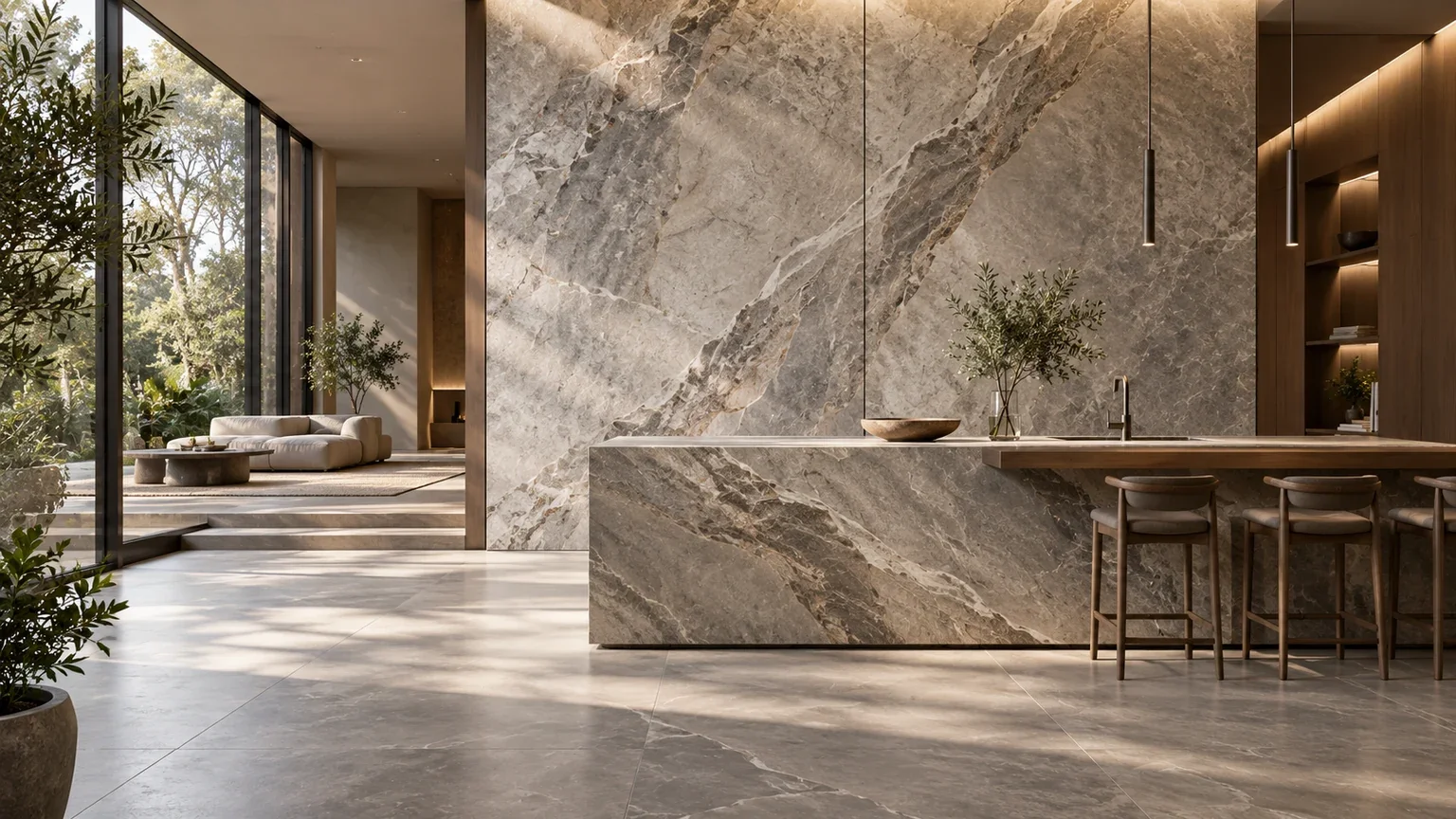
Architectural surfaces can connect the floor, walls and furniture into one composition. AI-generated concept illustration; not a photograph of a completed project.
Walking through recent international exhibitions of ceramic design and manufacturing, I was struck by a change in perspective. The most interesting question was no longer simply how efficiently a factory could produce tiles. It was what those tiles—and increasingly, those larger surfaces—could become.
A wall that defines a hotel lobby. A kitchen island that becomes the centrepiece of a home. A bathroom where the floor, walls and vanity form a coherent composition. These are not merely different places to install the same product. They invite a different way of thinking about its purpose. Manufactured mineral surfaces already serve applications ranging from wall coverings to worktops and furniture. [1]
The distinction matters commercially as much as aesthetically. When ceramic is considered only a floor covering, the conversation can become dominated by dimensions, price and availability. When it is considered an architectural surface, the conversation expands to identity, atmosphere, material expression and the quality of the finished space.
“The opportunity is not simply to make a bigger tile. It is to create a more valuable role for the material.”
When the surface becomes the focal point
Imagine entering a room where a stone-like wall is the first thing you notice. Its pattern establishes the composition. Its texture interacts with the lighting. Its colour connects the furniture, floor and surrounding architecture.
That surface is doing more than covering a wall. It is helping define the room.
Flooring remains important, and it can itself be a powerful design feature. But a prominent vertical surface invites direct attention. It becomes part of how a place presents itself.
Large formats can strengthen that effect. Consider a square wall clad in sixteen square tiles rather than two full-height slabs. The second arrangement has fewer internal joints, allowing the pattern to read across a broader area with less interruption. This is a geometric illustration, not a claim that large slabs eliminate the need for joints.
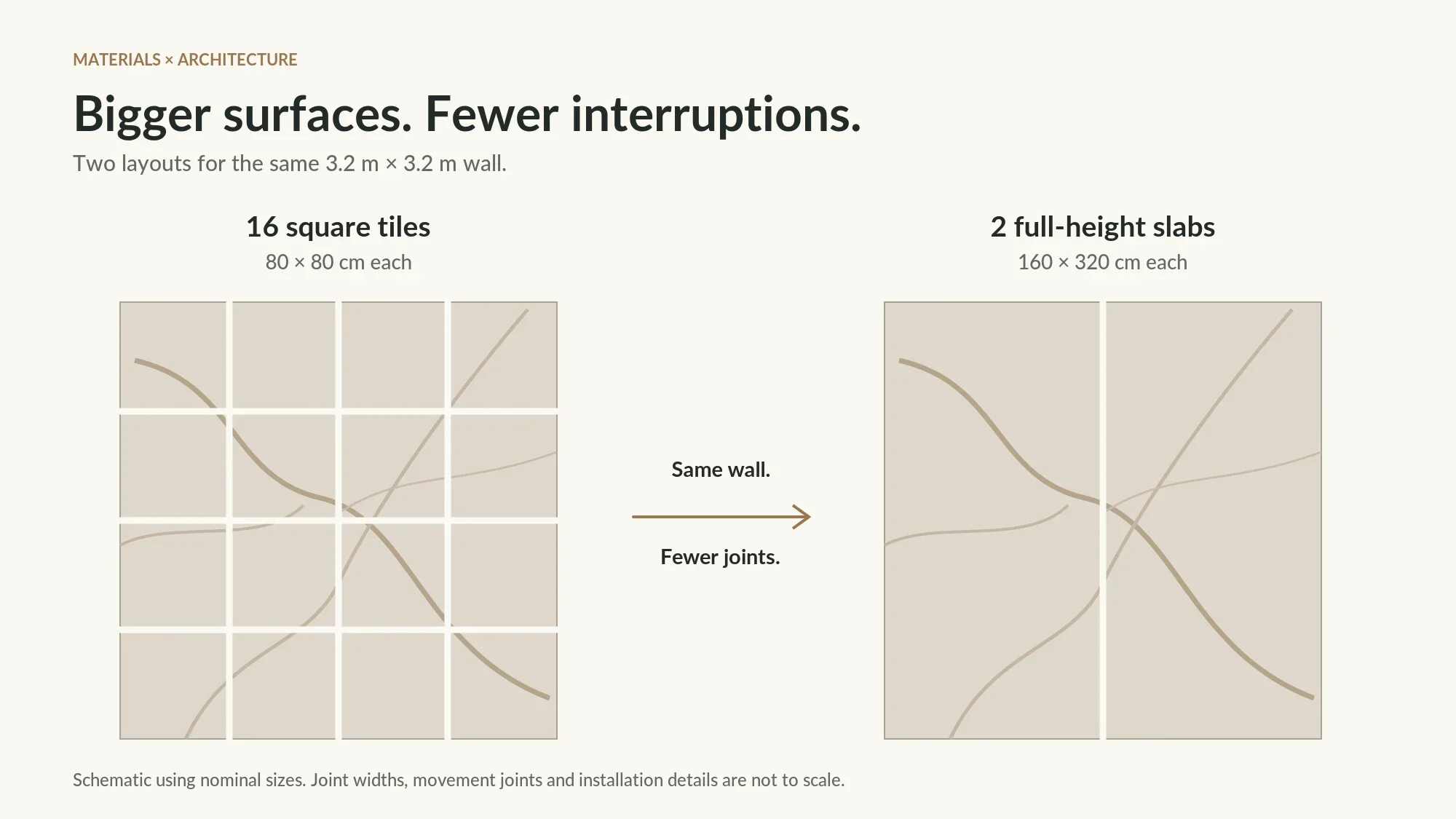
The same wall, a different visual rhythm: sixteen square tiles versus two full-height slabs. Schematic using nominal sizes; joint widths, movement joints and installation details are not to scale.
Yet size alone is not the design. An enlarged pattern can be beautiful, overwhelming or simply repetitive. The creative task is to understand scale, proportion, lighting and the relationship between neighbouring surfaces.
A manufacturer thinking in this way is no longer asking only, “What does this tile look like?” It is asking, “What will this material do to the space?”
What is sintered stone—and why does it matter for large slabs?
Sintered stone is an industrially manufactured mineral surface. A prepared mineral mixture is compacted and then subjected to high-temperature processing to create a dense material. Its characteristics depend on both its formulation and the manufacturing process. [1]
An important distinction is often lost in commercial discussion: “large slab” describes a format; “sintered stone” describes a material category and manufacturing approach. They are related, but they are not interchangeable terms. Porcelain production also involves sintering, so the word alone should not be treated as proof that one product is inherently superior to another. [5]
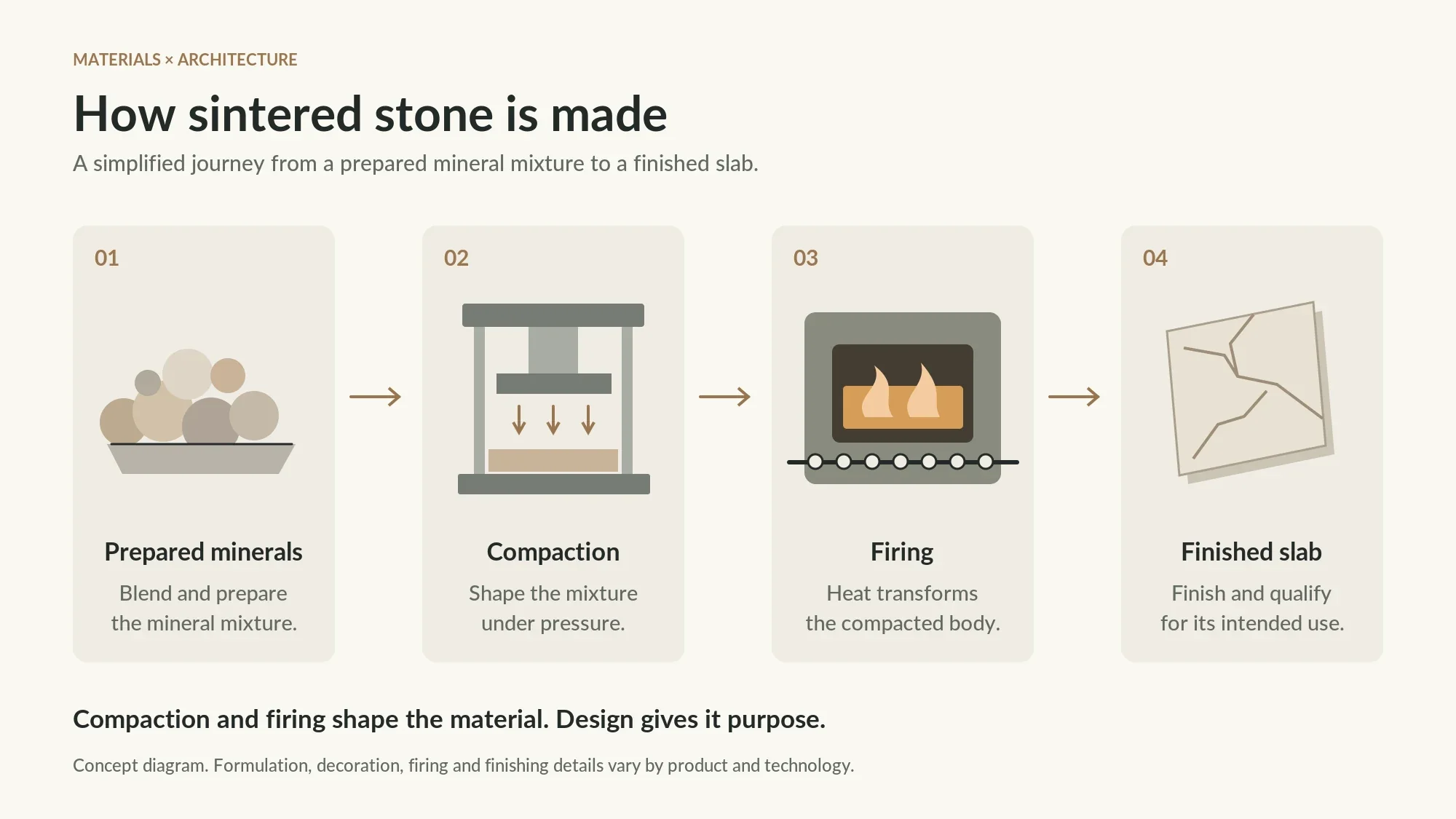
A simplified sintered-stone process: prepared minerals, compaction, firing and finishing. Formulation, decoration and process details vary by product and technology.
Why does this matter? Because the architectural opportunity requires more than an increase in surface area. It requires control over the material: its composition, consistency, dimensions, thickness and behaviour during fabrication and use. Modern slab-forming equipment accommodates different formats and thicknesses, allowing product development to follow the intended application. [2]
The commercial significance is the ability to approach the slab as a material from which architectural elements can be made—not merely a module to be repeated across a floor.
That does not remove the need for technical judgement. A wall panel, a countertop and an exterior installation have different demands. The product and installation system should be selected for the actual application, not assumed suitable because of a material label. [1][6]
The opportunity lies in the combination of format, material performance and design—not in any one of them alone.
From a printed image to material character
Another important development is the movement beyond appearance alone.
There is a difference between a surface carrying an image of stone and one whose texture, contour and visual pattern work together to suggest material depth. Specific decoration systems can coordinate effects on the surface with decoration inside the slab body. [4]
Through-body veining is particularly relevant to this distinction. It refers to decorative features extending into the material rather than existing solely as a surface image. Specialised production systems can match veins formed within the body to graphics applied on the face. This is a specific capability—not an automatic characteristic of every large slab or every product sold as sintered stone. [3]
These possibilities make the relationship between technology and design more interesting. Machinery is not merely reducing the cost of reproducing an existing product. It is expanding what a designer can create.
But the equipment does not decide whether a pattern is elegant, whether a texture is appropriate or whether a collection has a recognisable identity. That still requires creative judgement.
What ceramics can learn from fashion
In this respect, ceramics has something in common with fashion. Manufacturing makes an idea repeatable; design gives people a reason to choose it.
The useful lesson is not rapid obsolescence. Architectural surfaces should not need to become unfashionable every season. The more relevant lessons are creative direction, coherent collections, attention to detail and a clear point of view.
Collaboration with artists and designers can introduce different ways of thinking about colour, pattern and material. But a meaningful collaboration should translate that perspective into architecture—not simply enlarge an existing motif and place it on a slab.
For architecture, the goal should be lasting desirability rather than constant novelty.
The market opportunity extends beyond flooring
Once the product is understood as an architectural surface, the commercial opportunity becomes broader. A manufacturer can potentially participate in more of the same project: not only the floor, but also selected walls, counters and furniture elements. These applications are already represented in commercial mineral-surface offerings. [1]
The opportunity is therefore not limited to selling more square metres of an existing category. It can also involve improving the product mix, serving additional applications and earning a greater share of the customer’s architectural-finishes budget.
Consider a renovation. Replacing the entire floor may not be necessary, but transforming a kitchen, bathroom or feature wall may still create a purchase opportunity. A commercial space may similarly use a distinctive surface selectively, concentrating expenditure where it has the greatest visual impact.
This suggests a different approach to market development. Rather than starting with available factory capacity and searching for somewhere to sell it, the business starts with a design problem, an application and a customer willing to pay for the solution.
The strategic position can also change: from an interchangeable supplier to a source of distinctive products, design understanding and technical confidence.
None of this guarantees a premium price. Customers can choose another surface, another material or a simpler design. A theoretical opportunity is not the same as an order book. The commercial task is to demonstrate why the proposed surface deserves its place in the project.
Efficiency and differentiation answer different questions
An efficient conventional tile line can be a sound investment. Where it lowers unit cost, improves consistency or resolves supply constraints, it can strengthen an existing business substantially.
Larger square formats can also be commercially attractive. Nor is design-led development exclusive to large slabs. The distinction is not “ordinary tiles are outdated” and “large slabs are the future”. It is the difference between an efficiency-only investment thesis and a broader product-and-market development thesis.
An efficiency-only approach asks how to manufacture a broadly similar product at a lower cost and higher volume. That can improve competitiveness, but it does not necessarily change the customer’s reason for buying.
A design-led approach asks whether the manufacturer can serve a different need, create stronger product preference and participate in more valuable applications. Efficiency remains essential, but it supports a more ambitious commercial proposition.
These approaches are not mutually exclusive. The strongest case may combine disciplined manufacturing with distinctive products. What deserves scrutiny is the assumption that a faster line, by itself, constitutes a complete growth strategy.
Higher output becomes valuable only when it can be sold at an acceptable return. A higher selling price also means little without accounting for design development, fabrication, logistics, installation support, working capital and the capital invested.
The right comparison is therefore not simply production capacity against production capacity. It is the full business model against the full business model.
“Efficiency improves how a product is made. Design strengthens why it is chosen.”
Design needs materials science—and architectural understanding
Treating design seriously requires more than choosing attractive graphics before a launch. It means understanding how a collection will work across applications, which qualities should distinguish it and whether its appeal will endure.
The same applies to materials science. Experimental research on porcelain compositions shows that formulation and firing conditions influence properties including porosity, strength and deformation. What goes into the body—and how it behaves in production—matters to the finished result. [5]
That makes the relationship between designers and engineers central to the opportunity. The designer explores the intended effect. The materials specialist and process engineer determine how it can be achieved consistently. Neither discipline should be reduced to approving the other’s finished work.
This also connects product development with ceramic supply-chain resilience: the creative promise must be supported by qualified materials and reliable industrial execution.
Architects bring another essential perspective. A surface intended to shape architecture should be developed with an understanding of how it will be specified, detailed and incorporated into a building. Interior designers remain important, but the conversation should extend beyond decoration to the architectural application itself.
Creative capability, materials knowledge and project understanding are complementary parts of product development. A beautiful sample is only the beginning. The real achievement is a surface that retains its intended character when manufactured, fabricated and installed.
The finished space is the real test
Large surfaces place particular importance on execution. Dedicated installation guidance exists for gauged porcelain panels and slabs; the finished assembly depends on appropriate preparation, supporting construction and installation methods. [6]
For a manufacturer, the implication is straightforward: the quality promise cannot end at the factory gate. Technical information, application guidance, dependable delivery and competent installation support belong within the product proposition.
This also changes how a product should be presented. A small sample can communicate colour and finish. It cannot fully demonstrate the composition of a large wall, the continuity of a pattern or the relationship between a surface and the surrounding room.
The business should therefore be evaluated from the customer’s end of the process. Does the finished space deliver what the design promised? Was the material appropriate? Could the project team work with it confidently? Would they choose it again?
The move towards architectural surfaces is not an argument against manufacturing excellence. It asks manufacturing excellence to serve a larger purpose.
Nor is it simply a race to produce the biggest possible slab. A large product without a compelling design or a convincing application can remain just another product competing on price.
The more meaningful opportunity is to unite artistic judgement, materials science and industrial discipline around surfaces that people deliberately choose.
“A factory measures what it produces in square metres. The customer experiences what those square metres make possible.”
Selected technical reading
1. Mineral surfaces: material formation and architectural applications
2. Compaction technology for slabs and tiles
3. Synchronising through-body decoration and surface graphics
4. Coordinated surface and in-body decoration
5. Research on ceramic composition, firing and deformation
6. Installation guidance for gauged porcelain panels and slabs
About the author
Desra Ghazfan writes about technology, business and industrial development, exploring how engineering, design and disciplined management create lasting value. Read the author biography.
Explore more Business & Industry insights.