Sustainable Ceramic Industry: Better Factories, Stronger Businesses
What Essenza’s experience reveals about cleaner energy, circular production and the business value of environmental responsibility.
A sustainable ceramic industry connects energy, water and materials within a better production system. Editorial illustration; not a photograph of Essenza’s factory.
Sustainability in the ceramic industry should not begin with a marketing claim. It should begin with a production question: how can we create lasting architectural value while using less energy, less water and fewer virgin raw materials?
That question connects environmental responsibility with industrial competitiveness. The objective is not simply to make a factory look greener. It is to make the business more efficient, more resilient and more useful to the society around it.
Essenza provides a practical case study. We recently signed an agreement to introduce solar power for its factory operations, as part of IKAI’s commitment to sustainability. But solar is a continuation of that commitment—not its starting point, and not the complete solution.
A sustainable factory is a system, not a single installation
Ceramic manufacturing involves preparing materials, forming, drying and firing them. Improving its environmental performance therefore requires attention to the entire production process, not only its electricity supply. The European Commission’s ceramic-industry reference document treats energy efficiency, water management, waste recovery and pollution control as connected priorities. [1]
Solar photovoltaic panels generate electricity. They do not, by themselves, replace the gas used to fire a conventional kiln. A credible transition must address electricity and process heat separately, while improving how the factory uses both.
This distinction matters. A solar agreement is a meaningful step toward cleaner operations. It is not evidence that a factory already runs entirely on renewable energy or that its products are carbon-neutral.
Essenza: building on existing practices
At Essenza, the foundations already include kiln waste-heat recovery, a wastewater treatment and management system intended to minimise groundwater use, and the reuse of suitable production defects and waste as raw materials.
These practices share a straightforward principle: recover value before buying more resources or disposing of what remains.
Heat recovery puts otherwise-lost thermal energy back to work. Treating and reusing suitable process water can reduce the requirement for fresh water. Recovering suitable ceramic residues can reduce material disposal and replace some virgin inputs. The engineering details differ, but the logic is consistent. [1]
The solar agreement adds another element to this approach. Its operational contribution will become measurable after implementation: how much electricity it supplies, how much purchased electricity it displaces and what that means for the factory’s emissions.
For us, sustainability is not a collection of unrelated projects. It is a way of improving the production system over time.
The next stage: better equipment, more circular materials and alternative gas
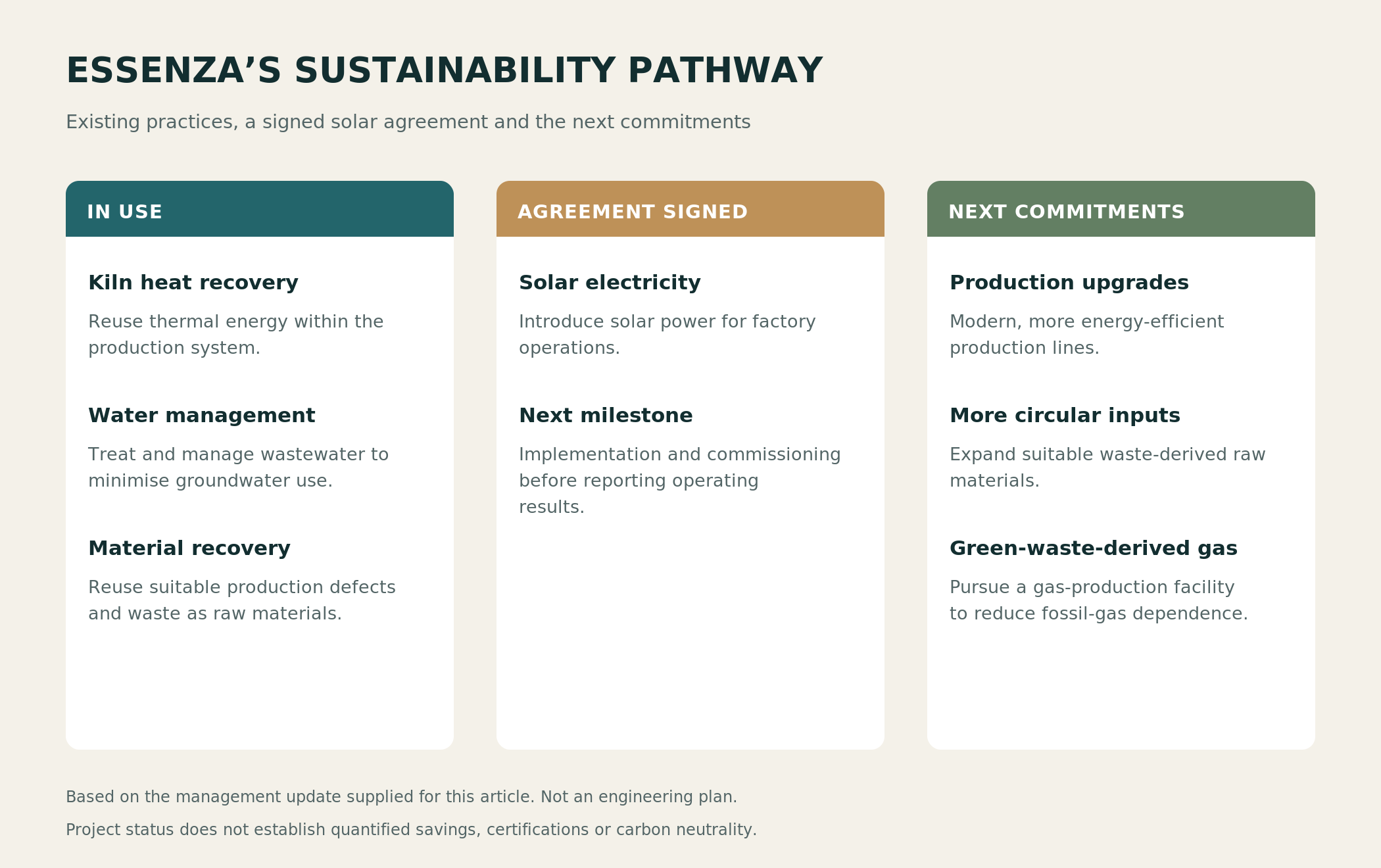
Essenza’s sustainability pathway distinguishes existing practices, the signed solar agreement and forward commitments. Based on the management update supplied for this article; no quantified savings are implied.
Essenza is committed to upgrading its production lines with modern, more energy-efficient technology, expanding the use of suitable waste-derived raw materials, and pursuing the procurement of a gas-production facility using green waste to reduce reliance on fossil gas.
These are forward commitments, distinct from the measures already in use and the solar agreement already signed.
Modernisation should be judged by the resources required to produce saleable, specification-compliant ceramics—not simply by the age or capacity of a machine. Contemporary kiln systems illustrate how heat recovery and better combustion control can be integrated with production stability and product quality. [8]
Similarly, increasing waste-derived content must remain a materials-engineering decision. A useful secondary raw material must work reliably within the ceramic formulation. Recovery is not progress when it creates more rejects, compromises durability or merely transfers an environmental burden elsewhere.
Green-waste-derived gas also requires a precise approach. Biogas, upgraded biomethane and gas produced through biomass gasification are different technical pathways; the appropriate route depends on the feedstock and intended use. They should not be treated as interchangeable labels. [3]
The environmental case must consider feedstock sourcing, processing, transport, gas losses, combustion emissions and residual-waste management. In particular, methane leakage can materially weaken the climate benefit of biogas and biomethane projects. Renewable origin is not a substitute for verified performance. [4]
Why sustainability creates value beyond the factory
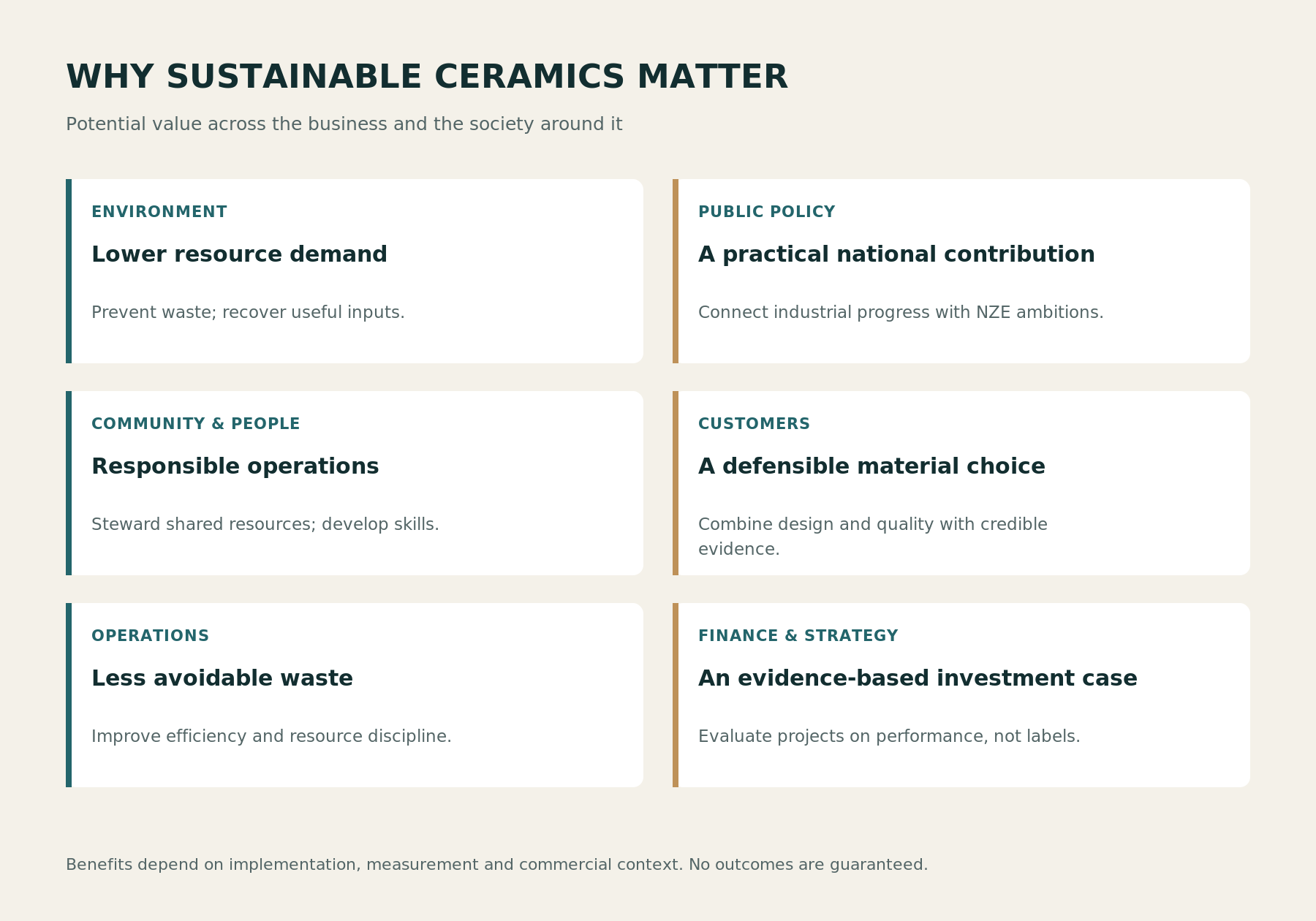
Potential value from sustainable manufacturing. Outcomes depend on implementation, measurement and commercial context.
Environmental value: reducing pressure at the source
The first benefit is the most fundamental: a manufacturer can reduce the resources it requires and the waste it generates for a given level of useful output.
The priority should be prevention before recovery. Avoiding a defective tile is better than repeatedly processing its material. Reducing unnecessary energy demand is better than supplying that demand with a cleaner source. Reuse remains important, but it should complement better production—not excuse avoidable inefficiency.
This also requires looking beyond carbon. Water, material extraction, dust, wastewater and other emissions belong in the same management conversation. A sustainable ceramic industry cannot improve one indicator while ignoring the rest.
Political and policy value: contributing to national priorities
Indonesia’s ambition to achieve net-zero emissions by 2060 or sooner gives industrial transition a national context. Factory-level improvements are one way businesses can translate that ambition into practical action. [2]
The political benefit is credibility as a contributor to national development. An industry that invests in efficiency, conserves shared resources and develops cleaner production has a stronger basis for constructive dialogue about energy infrastructure, technology adoption and industrial policy.
This is not a claim to preferential treatment. It is a more credible relationship between public support and private-sector responsibility: industry should be able to demonstrate what it is contributing, not only what assistance it needs.
Social value: being a better neighbour and employer
For surrounding communities, responsibility should be visible in how a factory manages shared resources and local impacts. Groundwater stewardship, effective wastewater management and proper control of operational emissions matter more than distant environmental slogans.
For employees, modernisation should include training. Better equipment creates lasting value only when operators, technicians and managers can use and maintain it properly. Sustainability should develop industrial capability alongside environmental performance.
The opportunity is to earn trust through everyday operations. That trust cannot be purchased with publicity, and it should not be confused with a formal licence or certification.
Commercial value: helping customers make a defensible choice
A ceramic product must still succeed on design, technical quality, durability, availability and price. Sustainability should strengthen that proposition, not replace it.
Its commercial value becomes clearer when a customer needs to assess the environmental implications of a material choice. LEED v5, for example, explicitly addresses embodied emissions alongside operational emissions and connects performance across the building life cycle. [5]
For manufacturers, this creates an opportunity to support architects, developers and project owners with credible product information. An Environmental Product Declaration, or EPD, communicates verified life-cycle environmental data. It is not, by itself, proof that one product is greener than another. [6]
The practical advantage is not necessarily a higher selling price. It may be a better-supported specification, a more credible tender submission or a stronger reason for a customer to retain the product when alternatives are considered.
Operational and financial value: using resources more intelligently
When less energy, water and virgin material are needed for a saleable unit of output, the business can become less exposed to those input costs. Recovery and substitution can also broaden the choices available to operations.
But good intentions do not make every project economical. Investment decisions should consider capital costs, financing, operating expenses, maintenance, reliability and product yield. Solar should be assessed against the actual agreement and generation profile; alternative gas against the full delivered cost and dependable supply of usable fuel.
Sustainability investments must earn their place in the business. The strongest ones improve environmental performance and operating discipline together.
Strategic and financing value: making progress understandable
A company with a defined baseline, credible projects and measurable outcomes can explain its transition more clearly to lenders, investors and partners. Indonesia’s sustainable-finance taxonomy, TKBI, provides a framework for classifying activities against sustainability criteria. [7]
That does not automatically make Essenza or any particular project eligible for green finance, nor does it guarantee cheaper borrowing. The opportunity is to present an investment case that can be evaluated on evidence rather than on a broad “eco-friendly” description.
Measure performance, not the number of announcements
The industry needs a small set of meaningful measures: energy used per saleable tonne, electricity supplied by renewable sources, groundwater withdrawn, water reused, material recovery and greenhouse-gas emissions.
Both absolute totals and production-adjusted measures matter. A factory can use less energy per unit while its total consumption rises as output grows. Product mix, thickness and yield must also be considered when comparing performance.
For ceramic surfaces, there is another important consideration: useful life. In evaluating a product over time, preventing premature replacement matters. Durable performance and enduring design should therefore remain part of the sustainability discussion—not be sacrificed to achieve a better-looking factory metric.
Better manufacturing is the point
Essenza’s experience is not presented as a completed transformation. It illustrates a practical sequence: improve what exists, recover resources already in the process, introduce cleaner electricity and develop the next generation of production and fuel solutions.
For Indonesia’s ceramic industry, the ambition should be clear. We should compete through design and quality while becoming more disciplined in how we use energy, water and materials.
Sustainability is not an alternative to competitiveness. Done properly, it is part of how competitiveness is built.
The goal is not simply a greener tile. It is a better industrial system behind every tile.
Sources
[5] U.S. Green Building Council. LEED v5: impact areas and building life-cycle framework.