
What the N250 achieved, why the programme stopped, and what Indonesia should carry forward
Indonesia’s Aviation Industry · Chapter 4 | Desra Ghazfan
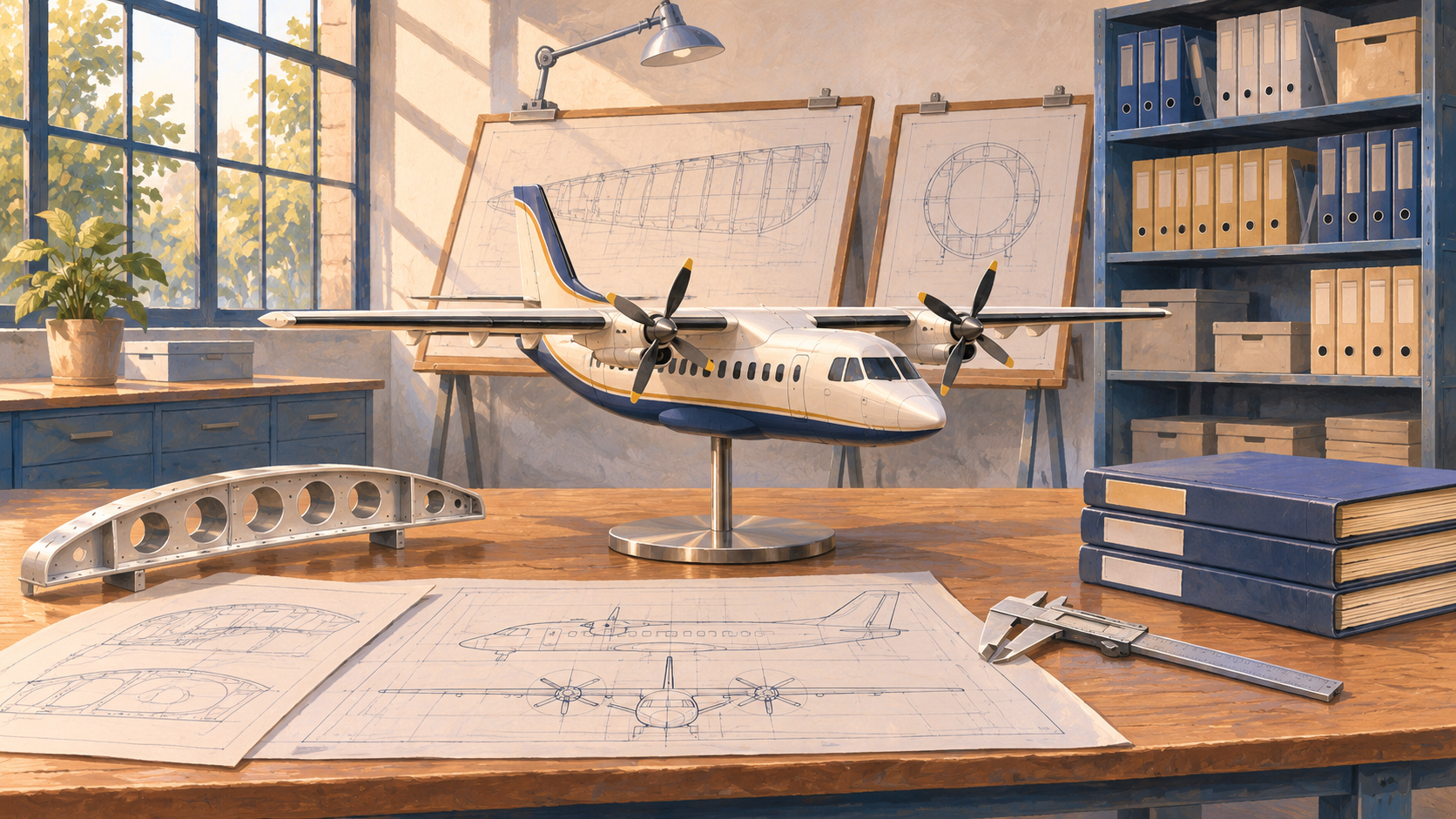
Engineering capability depends on people, methods, records and recurring work. Conceptual illustration; the model does not depict the N250 or a historical event.
AI-generated conceptual editorial illustration prepared for Desra Ghazfan.
On 10 August 1995, the N250 Gatotkaca took off from Bandung. For Indonesia, that flight made a difficult industrial ambition visible: Indonesian engineers could take responsibility for developing a regional aircraft, not only operate aircraft designed elsewhere. The date subsequently became the country’s National Technology Awakening Day. Indonesia’s Cabinet Secretariat on the N250 first flight.
The achievement deserves more than nostalgia. It deserves a serious account of what was built, what remained unfinished and why the distinction matters for the next investment decision.
My reading of Habibie’s legacy is that Indonesia acquired valuable engineering capability through an ambitious state-led programme, but did not complete the institutional and commercial system needed to sustain that ambition. The N250’s first flight was real. So were the certification work, financing requirements and production obligations still ahead of it.
Chapter 3 examined the economics of making aircraft. Chapter 4 asks how Indonesia reached that level of engineering capability—and how to preserve the achievement without repeating the vulnerabilities of the model that produced it.
Habibie used production to accelerate learning
Aerospace capability is difficult to acquire entirely in a classroom. Engineers learn by resolving design conflicts, qualifying a manufacturing process, investigating a test result and controlling a change that affects several systems at once. Those activities require real programmes and organisations that retain what they learn.
Habibie’s wager was to create those opportunities before Indonesia possessed a fully developed industrial ecosystem. Advanced enterprises would help build the skills and supplier relationships around them, rather than wait for every prerequisite to emerge independently.
A first-hand account of IPTN’s industrial development described four phases: acquiring technology through licensed manufacture; integrating technologies into new products; developing technologies further; and building a foundation in research. It identified the CN235 partnership with Spain’s CASA as an integration-stage programme and the N250 as a subsequent development effort. IPTN’s account of its technology-transformation strategy.
The important distinction is responsibility. Manufacturing an item to an established design develops process knowledge. Helping integrate an aircraft adds responsibility for interfaces, performance, configuration and the consequences of change. Neither activity is trivial; they create different capabilities.
The CN235 therefore belongs in the argument for more than historical completeness. Co-development offered a route between licensed manufacture and a more independent product ambition. Industrial partnerships can be vehicles for learning when Indonesian teams perform substantive engineering work and retain the competence to use it again.
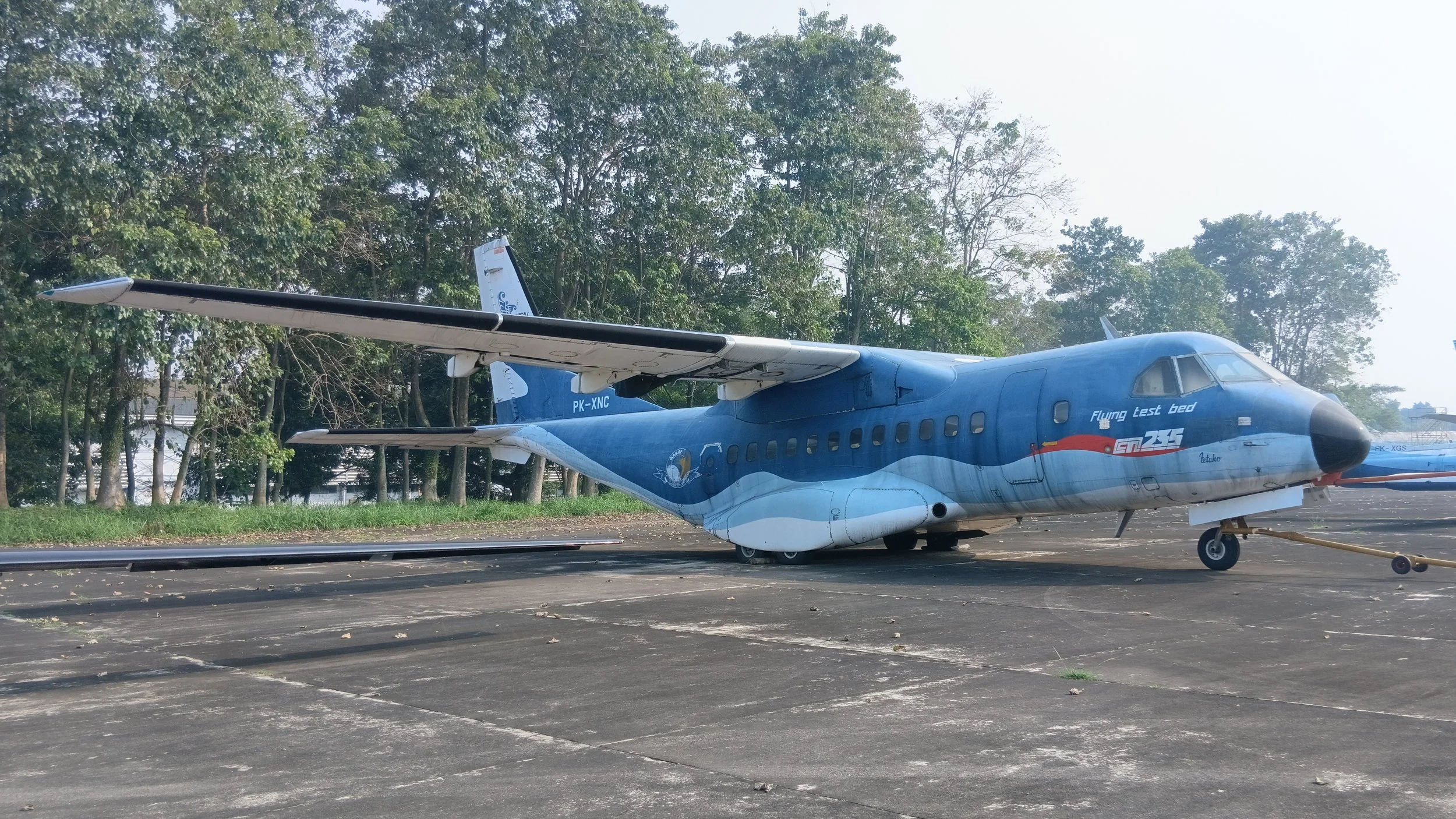
CN235 prototype PK-XNC “Tetuko” on static display at PTDI’s Bandung facility, photographed in June 2025. The CN235 was jointly developed by IPTN and CASA; this photograph shows the preserved prototype, not an aircraft in airline service.
Photo: Jauhsekali, via Wikimedia Commons, CC BY-SA 4.0. Unmodified. Photographer · Source photograph · CC BY-SA 4.0 licence.
There is also a limit to this approach. A manufacturer can acquire technical responsibilities faster than the surrounding financial, supplier and regulatory institutions acquire the capacity to support them. That is a reason to develop those institutions alongside the product—not a reason to deny the value of the engineering.
The N250 made the engineering ambition tangible
The N250 was a development programme with demanding systems work, not simply a national emblem painted on a purchased aircraft. An IPTN technical paper presented to the International Council of the Aeronautical Sciences in 1994 described electrically commanded, hydraulically powered flight controls and the analysis of interactions between the control system and the aircraft’s structure. IPTN technical paper on the N250.
That work matters because integration is where separate technologies have to operate as one aircraft. It calls for specialist knowledge, disciplined testing and decisions that can be traced and defended. Public discussion should recognise the teams, methods and facilities behind the first flight, not reduce the achievement to a single ceremony or personality.
But the development milestone and the industrial outcome are different questions. A flying prototype demonstrates important capabilities. It does not, on its own, establish an approved design for airline service, a repeatable production system, a financially sustainable order book or dependable support for operators.
The N250 did not progress into a certified, serially produced airliner. At the prototype’s museum handover in 2020, PTDI director Sukatwikanto described the programme’s cessation and the absence of funding for further certification testing. PTDI’s account, reported at the handover. The work already accomplished should be recognised without treating the remaining work as a formality. That distinction is essential when the history is used to justify a future programme.
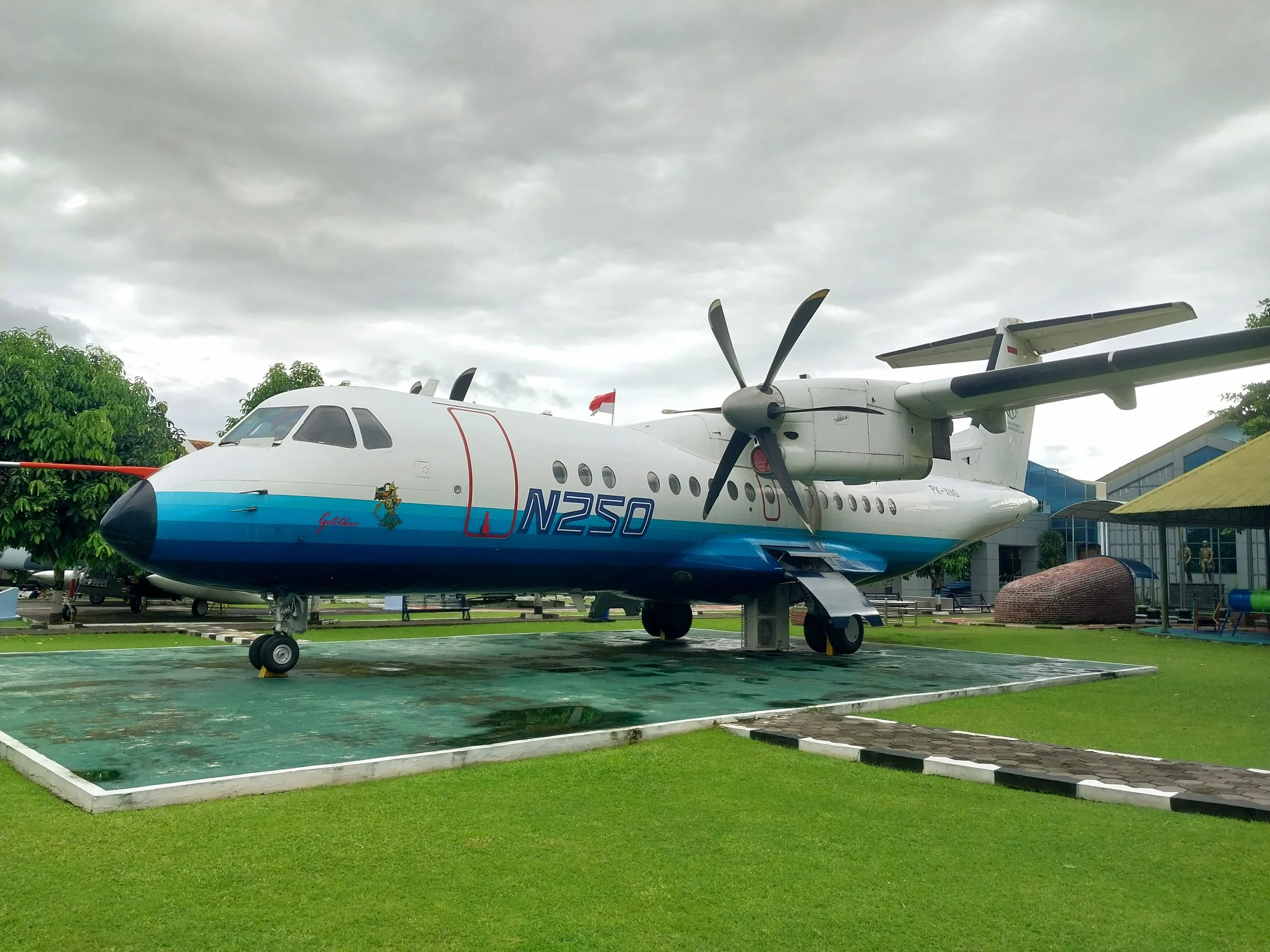
N250 Gatotkaca on display at the Indonesian Air Force’s Dirgantara Mandala Museum in Yogyakarta, photographed in November 2025. This is a museum photograph, not a photograph of the 1995 first flight.
Photo: Febri Ady Prasetyo (Risanprasetyo), via Wikimedia Commons, CC BY-SA 4.0. Unmodified. Photographer · Source photograph· CC BY-SA 4.0 licence.
What the 1998 agreement actually changed
The interruption cannot be explained without the Asian financial crisis and the policy commitments made during it.
In the Indonesian government’s memorandum of 15 January 1998, published by the IMF, paragraph 13 committed to discontinuing budgetary and extra-budgetary support and credit privileges for IPTN projects immediately. Indonesia’s January 1998 memorandum, paragraph 13. On 26 January, the IMF reported that special funding for IPTN had been rescinded. IMF follow-up on implementation.
That provision is more specific than saying the IMF prohibited Indonesia from possessing aircraft technology. It concerned support and credit privileges. For a capital-intensive development programme, the financing implications matter: engineering continuity depends on the ability to pay people, suppliers and the cost of testing over many years.
The historical fact does not settle the counterfactual. It cannot tell us that the N250 would certainly have become commercially successful if funding had continued. Equally, the absence of a completed commercial programme does not establish that the engineering effort had no value.
The useful question is what would have been required to continue responsibly: a funded route through certification, a stable customer configuration, credible buyers, production working capital and an organisation able to support the aircraft after delivery. Continued political commitment alone would not answer those questions.
For a future programme, the lesson is to reduce dependence on any single source of continuity. Multi-year funding arrangements, explicit fiscal exposure and independent review can make a programme more resilient. They cannot make it immune to a national crisis, and they should not become a promise to finance any cost indefinitely.
Build the institutions alongside the aircraft
The next industrial effort should be assessed against responsibilities that extend beyond first flight.
A continuing design organisation. Engineering competence resides in people, records, tools and repeated practice. Indonesia needs teams able to maintain configuration control, investigate problems and carry design knowledge into subsequent work. Preserving a drawing archive without sustained engineering activity is insufficient.
A credible certification process. The programme must generate evidence that the relevant authority can examine independently. Regulators need technical capacity and the freedom to require more work. In the US system, type certification and production certification address different responsibilities; a production certificate concerns the ability to manufacture products conforming to an approved design. That distinction illustrates why a prototype and a reliable delivery system are not interchangeable. FAA guidance on production certificates.
Repeatable production. Qualified suppliers, stable processes, traceable parts and controlled changes determine whether the next aircraft can meet the same standard as the previous one. A factory’s strategic value depends on dependable output, not floor area or equipment alone.
Customers who can take delivery. Announced interest must be translated into enforceable commercial commitments and financing. Customer concentration also matters. If the manufacturer, its lenders and most buyers are vulnerable to the same economic shock, a large headline order book may offer less protection than it appears to provide.
Support for the aircraft in service. Spares, maintenance information, training and engineering assistance need an organisation and a budget. An airline is buying the ability to operate a fleet over time. The sale therefore creates obligations well beyond delivery day.
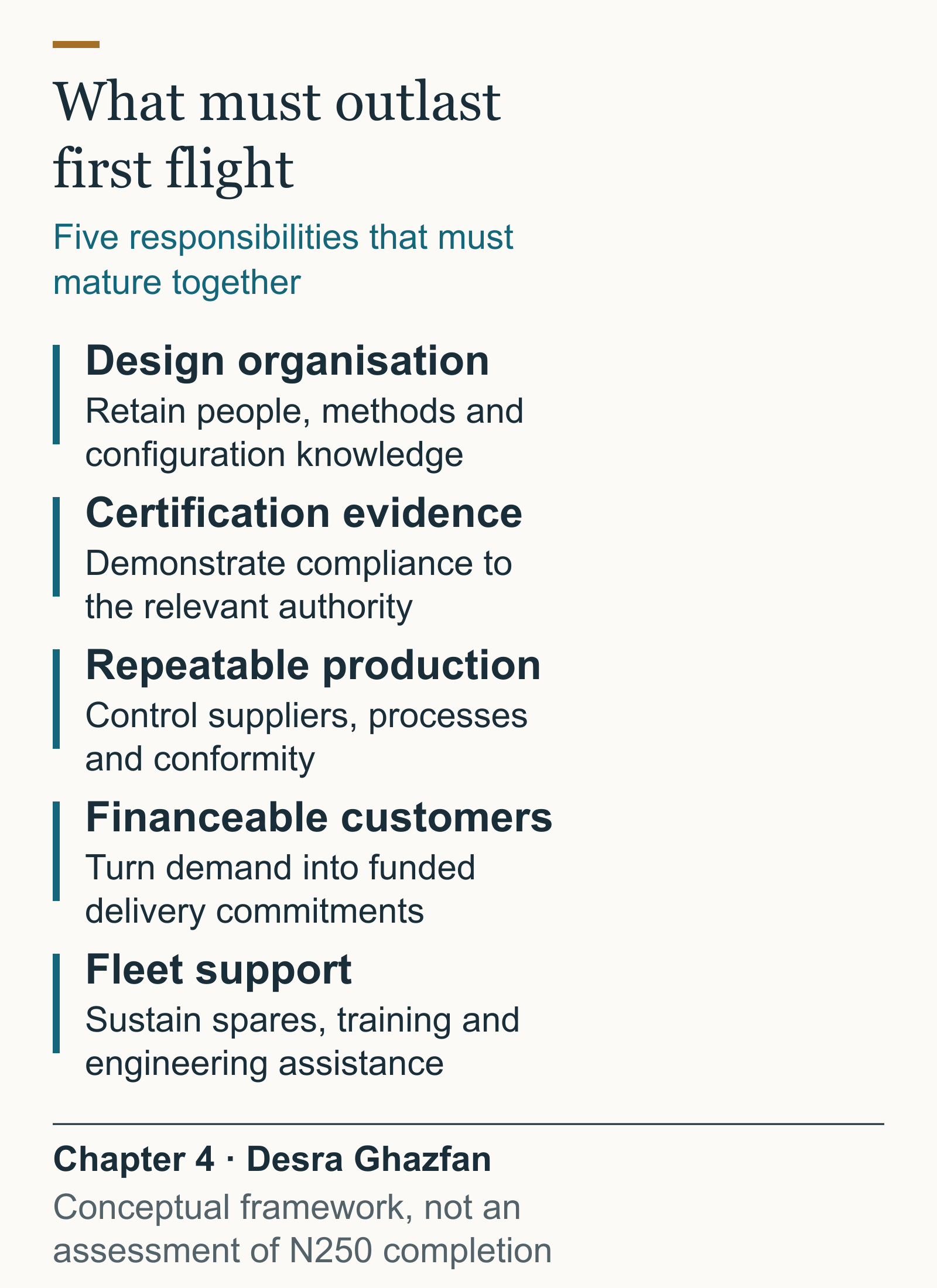
An aircraft programme needs five responsibilities to mature together. This is an analytical framework, not a scorecard of N250 completion or a sequence of tasks.
Analytical graphic prepared for Desra Ghazfan, based on the argument in Chapter 4.
-
A continuing design organisation retains people, methods and configuration knowledge. Certification evidence demonstrates compliance to the relevant authority. Repeatable production controls suppliers, processes and conformity. Financeable customers turn demand into funded delivery commitments. Fleet support sustains spares, training and engineering assistance. All five responsibilities need to develop together; their order on the page is not a timeline or hierarchy. The framework is the author’s synthesis, not an assessment of how much of each responsibility the N250 programme completed.
These responsibilities must mature together. They are not a sequence in which certification, customers and support can wait until engineers have finished the aircraft.
Separate capability funding from product approval
Indonesia should distinguish two decisions that are too often bundled together.
The first is whether the country should sustain aerospace capability. There is a strong case for maintaining selected engineering teams, test facilities, supplier competence and the ability to adapt aircraft to national requirements. That capability can serve several programmes and partners.
The second is whether a particular new aircraft should proceed to a major development commitment. That requires a product-specific judgment about requirements, certification, customers, cost, schedule and support. A national need for engineering competence does not automatically validate every proposed airframe.
Separating the decisions makes policy more credible. It allows government to protect useful knowledge while requiring a weak product proposal to be redesigned, partnered, deferred or stopped. It also reduces the pressure to defend optimistic commercial assumptions merely to keep an engineering institution alive.
The mechanisms should be explicit. Capability programmes should identify the skills and infrastructure being funded, the recurring work that will use them, and the evidence of competence gained. Aircraft programmes should have independent reviews before major funding commitments, with clear conditions for proceeding and a credible plan for retaining valuable people and knowledge if the product changes direction.
Partnerships should be evaluated with the same discipline. Which engineering tasks will Indonesian teams perform? What technical information can they use? Which changes can they develop and obtain approval for? What repeat business will maintain the capability after the initial contract ends?
Those questions are more useful than treating a domestic-content percentage as a complete measure of industrial progress.
Carry the achievement forward
Habibie expanded the responsibilities Indonesians could aspire to hold in aerospace. The enduring task is to make those responsibilities sustainable through competent organisations, recurring work and accountable investment decisions.
The N250 should remain part of that discussion as evidence of an ambitious engineering effort and an unfinished industrial programme. Remembering the achievement accurately strengthens the argument for capability building. Examining its vulnerabilities strengthens the next programme.
Indonesia does not need to choose between respect for Habibie and commercial discipline. The next generation of engineers deserves both: work worthy of their abilities, and institutions capable of supporting that work beyond a first flight.
Continue the series: Chapter 2 — Aircraft Finance Is Part of the Aircraft · Chapter 3 — The Economics of Making Aircraft.
For the newsletter edition of this series, subscribe to Technology, Industry & Indonesia on LinkedIn.