
Indonesia’s Aviation Industry · Chapter 3
Certification, production scale and the capabilities Indonesia should control
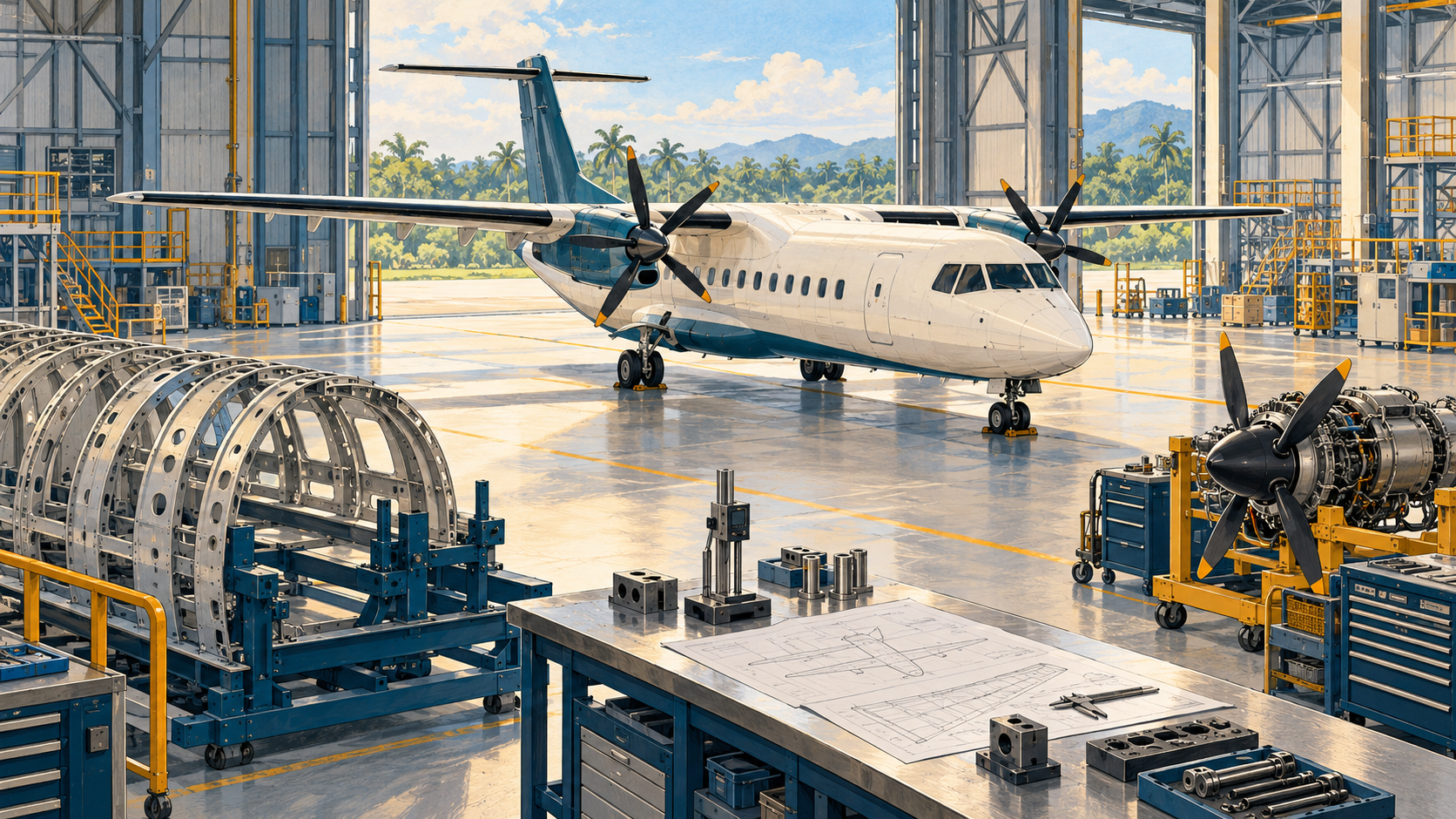
An aircraft depends on an industrial system of engineering, repeatable production and long-term support. (AI-generated editorial illustration prepared for Desra Ghazfan; conceptual, not documentary)
An aircraft programme commits a company to much more than designing and assembling an aircraft. It commits the company to producing a repeatable product, demonstrating compliance with safety requirements, managing suppliers and supporting operators long after delivery. Indonesia’s aerospace strategy must fund and govern that whole obligation.
Chapter 2 examined customer finance. Chapter 3 moves inside the industrial business: where costs accumulate, where value is earned and which capabilities Indonesia should own or develop through partnerships.
My argument is that Indonesia should preserve substantial engineering ambition while becoming more selective about the commercial risks it accepts. Domestic assembly, design responsibility, maintenance capability and a globally supported aircraft programme are different achievements. Each requires its own investment case.
Production rate changes the economics
Development spending begins before delivery revenue. Engineering teams, test equipment, tooling and compliance work must be funded while the product is still being defined. Customer deposits may cover part of this expenditure, but they also create delivery obligations. They are not a substitute for adequate programme capital.
The first aircraft off the line do not establish mature production cost. Early units can require additional labour, rework and supplier assistance. Cost reductions depend on design stability, repeatable processes, reliable suppliers and sufficient production volume. A learning curve is an outcome to earn, not a percentage to insert optimistically into a spreadsheet.
Rate matters as much as total demand. Delivering a given number of aircraft over twice as many years does not produce the same financial result. Engineering teams and facilities must be maintained for longer; inventory absorbs cash; and the programme takes longer to build the installed fleet over which it recovers its support investment.
Consider a simplified illustration, not an estimate for any Indonesian programme. US$1 billion of fixed programme expenditure requires 200 deliveries to recover if each aircraft contributes US$5 million after its incremental production and delivery costs. If that contribution falls to US$4 million, the requirement becomes 250 deliveries. Both figures exclude financing costs, the time value of money and additional fixed expenditure during delays. A credible investment decision needs the full cash-flow model, not this simple recovery calculation.
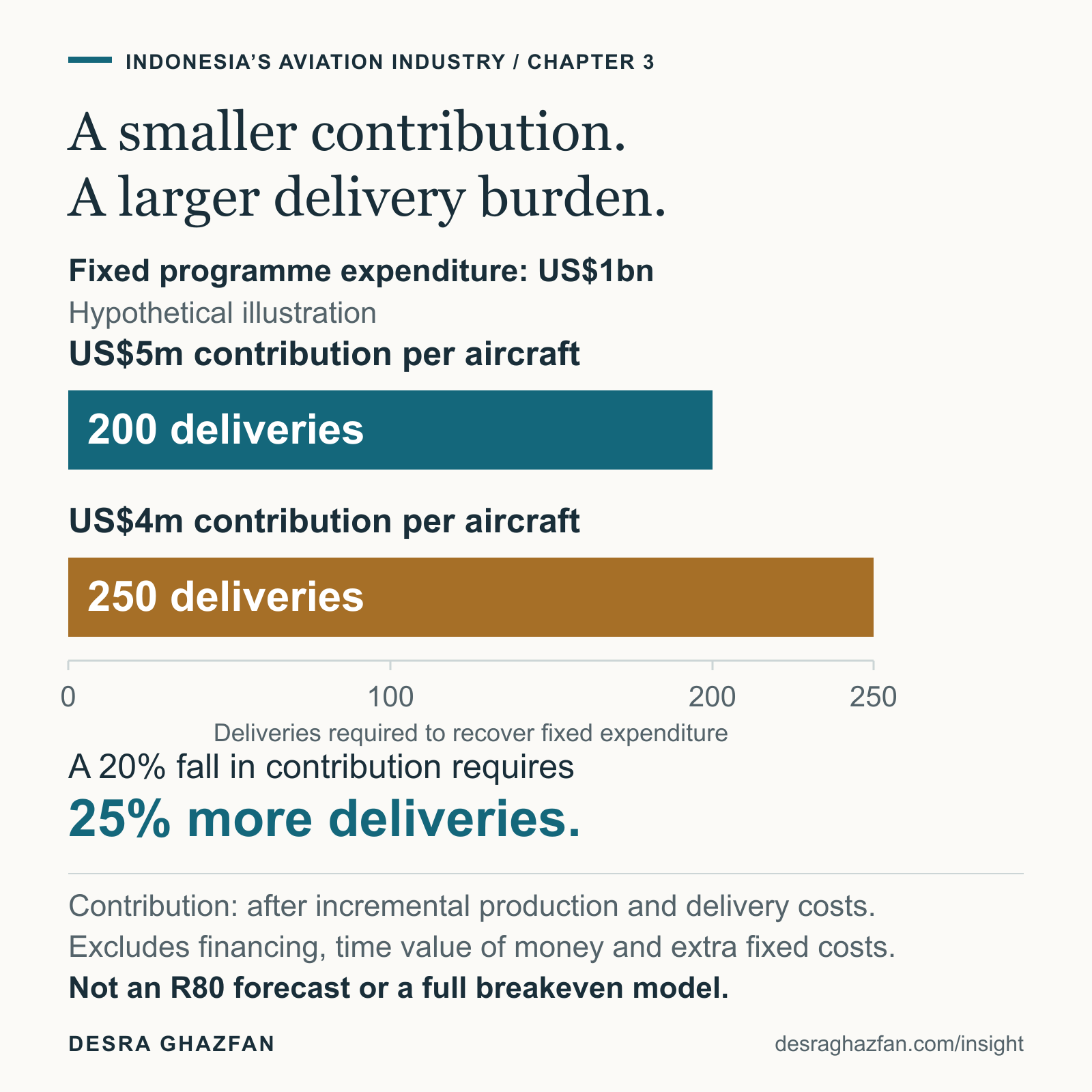
A 20% reduction in contribution per aircraft requires 25% more deliveries to recover the same fixed expenditure in this hypothetical example.
(Graphic prepared for Desra Ghazfan. Source: the hypothetical arithmetic in Chapter 3; no observed programme data)
-
SUMMARY
Bar chart comparing the deliveries required to recover a fixed US$1 billion of programme expenditure under two contribution assumptions.Fixed programme expenditure is assumed to be US$1 billion. At US$5 million contribution per delivered aircraft, 200 deliveries recover that expenditure; at US$4 million, 250 deliveries are required. Both bars start at zero; the second is 25% longer. Contribution is measured after incremental production and delivery costs. The calculation excludes financing, the time value of money and additional fixed expenditure during delays. These are hypothetical assumptions, not an R80 forecast or a full financial break-even model.
The relevant questions are therefore specific. What annual rate can funded customer commitments sustain? What happens if deliveries start later, suppliers increase prices or an early operator reduces its order? How much additional cash is required before the programme can support itself?
Certification must be built into the programme
Certification is not an administrative exercise after engineering has finished. Requirements, analyses, tests and configuration records must collectively demonstrate compliance. Changes made late in development can require further evidence and testing.
The distinction between design approval and production capability is important. In the US system, the FAA treats type, production and airworthiness certification separately. Its production-certificate process examines the organisation, facilities and quality system used to manufacture products conforming to an approved design. A successful prototype does not establish that the factory can repeatedly deliver conforming aircraft. FAA production certification guidance.
Export-market acceptance must also be planned. For example, Singapore requires an aircraft’s type certificate to be accepted by its Civil Aviation Authority before the relevant airworthiness-certificate application can proceed. Indonesian approval should not be treated as automatic acceptance in every intended market. CAAS airworthiness requirements.
The practical implication is to fund certification specialists and engage the relevant authorities early. Programme schedules need time for resolving findings and repeating work where necessary. Political delivery dates cannot replace that evidence.
The state also needs to separate its roles. Supporting a manufacturer and supervising its compliance are different responsibilities. Indonesia should strengthen the regulator’s technical capacity and independence alongside industry development. Confidence in the approval process is part of the product’s credibility.
Responsibility continues after delivery. FAA guidance requires design approval holders to report specified failures, malfunctions and defects, and to make instructions for continued airworthiness, including changes, available to relevant parties. The industrial implication is that the organisation supporting the approved design must be sustained beyond the development phase. FAA design approval holder obligations.
Industrial value extends beyond final assembly
An aerospace strategy should examine the businesses around the aircraft, not assume that the company performing final assembly captures all the important value.
Indonesia already participates in international aircraft production. Airbus identifies PT Dirgantara Indonesia as a supplier of components for the A320 Family and A350, as well as a producer of C295 structures. Airbus on its Indonesian industrial partnerships.
Qualified production for an established programme can develop manufacturing competence and recurring business without requiring Indonesia to bear the full cost of launching a new airliner. It does not, by itself, establish profitability or ownership of the complete aircraft design. The next question is which additional responsibilities and repeat contracts that capability can support.
| Activity | What can create value | What must be sustained |
|---|---|---|
| Aircraft design and systems integration | Control of configuration, performance and product development | Engineering teams, test capability and responsibility for the design |
| Aerostructures and components | Repeat production for qualified customer programmes | Quality, delivery reliability, competitive cost and working capital |
| Engine and avionics partnerships | Specialist manufacturing, repair, integration and technical learning | Licences, technical data, skills and economically sufficient workload |
| Maintenance, repair and overhaul | Fleet availability and repeat customer business | Approvals, tooling, material access and dependable turnaround |
| Modifications and mission integration | Adaptation to customer requirements and operational needs | Design data, integration expertise, testing and applicable approvals |
| Aircraft finance and asset management | Customer access to aircraft and management of asset risk | Underwriting, funding, technical assessment and remarketing capability |
These are different business models. Maintenance requires its own customer base and economics; it is not automatically profitable because aircraft need servicing. A component contract can generate industrial learning while still becoming unattractive if pricing, rejection rates or payment terms are poorly managed. Design responsibility creates strategic options but also long-term expenditure and accountability.
The same discipline applies to partnerships. Indonesia should ask which technical tasks local teams will perform, which data they can use, how their work will be approved and whether the contract supports repeat production. An announcement or assembly licence does not answer those questions.
Strategic autonomy depends on usable rights and competence
A useful way to assess aerospace autonomy is to distinguish six capabilities. These are strategic categories, not regulatory classifications or a requirement that every company climb the same ladder.
Operating aircraft: access to air transport, with dependence on the supporting product system.
Maintaining aircraft: the ability to inspect, repair and overhaul within the relevant approvals and technical arrangements.
Producing aircraft or components: repeat manufacturing to an approved design and required quality standard.
Modifying and integrating systems: the ability to develop changes, assemble the evidence and secure the necessary approvals.
Holding design responsibility: maintaining the technical definition of a product and supporting its continued airworthiness within the applicable regulatory system.
Leading a complete aircraft programme: coordinating design, production, sales, customer-financing arrangements and long-term support, while carrying the associated commercial exposure.
A country can build a valuable industry through several of these capabilities without producing every subsystem domestically. A specialist supplier does not become strategically unimportant because it has no ambition to manufacture a complete aircraft.
Consider an aircraft that needs a new maritime-surveillance sensor. Domestic assembly alone may not give local engineers access to the interface data, structural analysis or software permissions required for the installation. Meaningful autonomy requires competent engineers, usable data rights, test facilities and an approval route. National ownership of a factory cannot substitute for those capabilities.
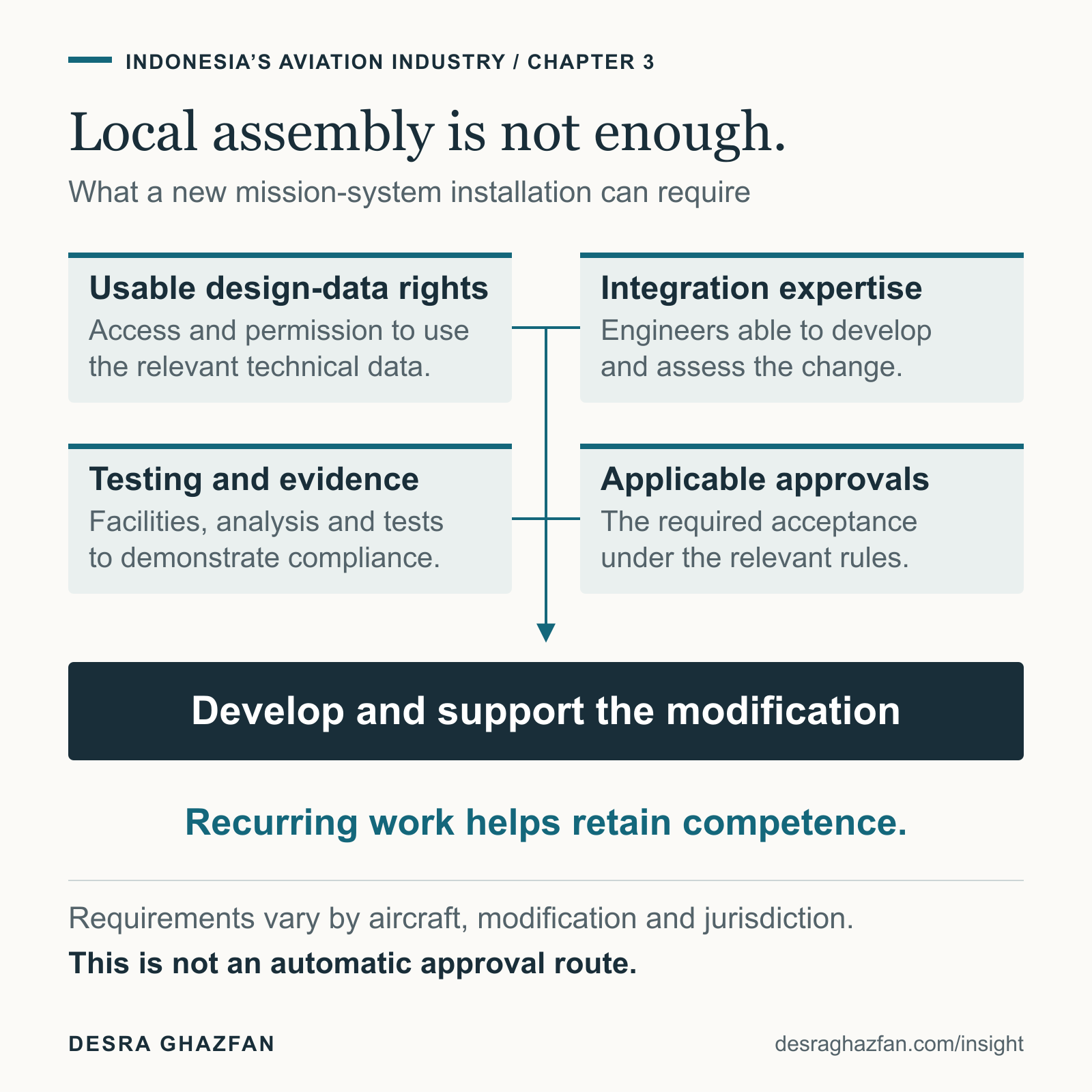
Local assembly alone does not establish the rights or competence to modify an aircraft. Requirements depend on the aircraft, change and jurisdiction. (Conceptual graphic prepared for Desra Ghazfan, based on the analytical framework in Chapter 3)
-
SUMMARY
Four equally weighted inputs connect to developing and supporting an aircraft modification. This is an analytical framework, not a regulatory checklist or automatic approval route.The diagram shows four inputs to developing and supporting a modification: access and permission to use relevant design data; engineers able to develop and assess the change; facilities, analysis and tests to demonstrate compliance; and the required approvals under the relevant rules. The inputs are not a sequence or hierarchy. Recurring work helps retain competence. The requirements vary by aircraft, modification and jurisdiction; the diagram does not establish an automatic approval route.
Design responsibility also does not mean freedom from regulatory oversight or freedom to modify a supplier’s proprietary technology. Contractual rights, export restrictions and safety approvals still matter. The objective is to understand and reduce critical dependencies, not to claim they have disappeared.
Make or buy decisions need explicit tests
Indonesia should assess each proposed capability against four questions.
Does control materially improve national options?
Priority should go to capabilities that protect fleet availability, enable essential missions or reduce exposure to a dependency that is difficult to replace. The strategic benefit must be identified, not inferred from a domestic-content label.
Can the capability be reused?
Engineering methods, testing facilities and qualified teams become more valuable when they serve several products or customers. A bespoke capability tied to one small order needs a different justification from a capability with recurring demand.
Is the workload sufficient?
A national fleet may justify local maintenance or selected modifications without justifying development of an entire engine family. Different activities have different minimum scales. The decision must reflect the actual market, including credible export opportunities.
Will the capability remain useful long enough to repay the investment?
Technology, product architecture and customer requirements can change during development. Partnerships should provide a path to upgrades and further learning rather than leave Indonesia with a process that becomes obsolete when a contract ends.
On that basis, my preference is to deepen design responsibility in selected product families, expand modification and mission-integration capability where demand supports it, and build competitive suppliers and support businesses. A larger clean-sheet aircraft remains an option, but its launch should depend on a complete commercial and technical case.
That is a disciplined way to pursue Habibie’s engineering ambition. It does not require judging every aerospace investment by whether it culminates in a new national airliner.
Fund capability and commercial products separately
Public funding should distinguish between an enduring capability and a particular product.
Capability funding can support specialist education, shared laboratories, test infrastructure and regulatory competence. Its results should be measured through qualified personnel, usable facilities, completed technical work and the ability to serve multiple programmes.
Product funding should sit within an accountable programme structure with a defined configuration, customer case, certification plan, supplier commitments, production economics and support budget. Funding should be released against independently reviewed progress, with explicit conditions for redesign, delay or termination.
If government requires a product for a public-service or strategic mission that cannot meet ordinary commercial returns, that obligation should be priced and funded transparently. It should not be concealed inside an optimistic sales forecast or an unexplained guarantee.
Government, programme sponsors and industry partners should agree what evidence will count as success: accepted deliveries rather than ceremonial handovers; qualified work rather than nominal offsets; engineering responsibilities and usable data rights rather than training attendance alone. Measures of quality, turnaround, repeat orders and cash requirements should sit alongside domestic value added.
Indonesia’s task is to develop organisations that can make and sustain those commitments. An aircraft factory is one part of that effort. The stronger national asset is the ability to design, produce, adapt and support selected products reliably—and to know which risks the country can afford to carry.
Previous chapter: Aircraft Finance Is Part of the Aircraft.
Follow the series in Technology, Industry & Indonesia.