
Two fictional Indonesian youth athletes face a track towards a coastal horizon; Dakar 2026 pathway editorial
Indonesia should use Dakar 2026 to establish a continuous development pathway for young athletes. The immediate task is to compete well. The strategic task is to turn that experience into better coaching, sustained support and measurable progress towards senior international performance.
The value of the Youth Olympic Games will depend partly on what happens after the delegation returns. A strong result can reveal potential. A difficult competition can expose a gap. Both become useful when someone is responsible for the next decision, the next intervention and the next review.
What Dakar 2026 offers
The Dakar 2026 Youth Olympic Games are scheduled for 31 October–13 November 2026 in Senegal. This will be the first Olympic sporting event on African soil. Competition will take place across Dakar, Diamniadio and Saly. The programme distinguishes 25 competition sports from 10 engagement sports; these are different forms of participation and should not be combined into a claim of 35 medal sports. IOC event overview · Sports programme
The Youth Olympic concept combines international competition with education and cultural exchange. That combination matters for athletes learning to manage an international Games environment while developing as people. The editorial question for Indonesia is how to convert a short period of exposure into a durable national capability. IOC media kit
Indonesia’s participation: the verified starting point
ANTARA reported on 9 October 2026 that Indonesia planned a 12-athlete delegation, evenly divided between male and female athletes, across nine sports under Chef de Mission Ita Yuliati. The sports were athletics, swimming, badminton, cycling, equestrian, judo, skateboarding, triathlon and wushu. This is a reported pre-Games delegation, rather than a final start-list certification. Delegation report
For this group, Indonesia can establish a practical demonstration of coordinated athlete development. The scale makes it possible to assign clear responsibilities, review individual needs and test whether support follows an athlete across competition cycles.
The proposal in this article is an editorial framework. It is not an announced NOC Indonesia programme or a promise that any particular athlete will qualify for a future Olympic Games.
Start with an individual development agreement
Every athlete should leave Dakar with an assessment that answers three questions: what did the competition reveal, what must improve, and who will provide the support?
That assessment should compare the athlete’s performance with relevant international standards. Depending on the sport, this may involve times, scores, technical execution, tactical decisions or performance across successive rounds. A finishing position alone cannot explain the development need.
The athlete, coach and federation should translate the assessment into a twelve-month agreement. It should specify a small number of performance priorities, the competition programme, access to specialist support, the expected cost and the dates for review. Education and welfare should sit within that agreement because an athlete’s ability to continue training depends on more than technical progress.
Build a pathway with decision points
A useful 2026–2032 framework has five stages.
2026: establish the baseline. Record the Dakar performance, the athlete’s own assessment and the support gaps revealed by preparation and competition. Complete a post-Games review while the evidence is still fresh.
2027: deliver the development plan. Prioritise technical work and appropriate international competition. Confirm that agreed services and funding actually reach the athlete. Review progress against the baseline rather than attendance at training camps.
2028: assess readiness for the next level. Los Angeles 2028 is a possible opportunity for athletes whose sport, eligibility, performance and qualification route support it. For others, the appropriate objective will be continued development. An early Olympic attempt should not become a universal requirement.
2029–2031: strengthen senior competitiveness. Use relevant national, continental and world competitions to test consistency and close specific gaps. Update the pathway when the evidence changes. Selection and funding decisions should be documented and explained to the athlete.
2032: evaluate Olympic readiness and the system behind it. Brisbane 2032 provides a longer planning horizon. Qualification remains conditional on the applicable rules and performance. Evaluate the programme through sustained progression, athlete welfare and successful transitions as well as Olympic representation. IOC future Olympic hosts
This chronology matters. Aichi-Nagoya 2026 ran from 19 September to 4 October, before Dakar. It cannot be presented as a post-Dakar milestone. Competition calendars should be built around each sport and athlete, with future events confirmed before being added to an individual plan. Official Asian Games dates
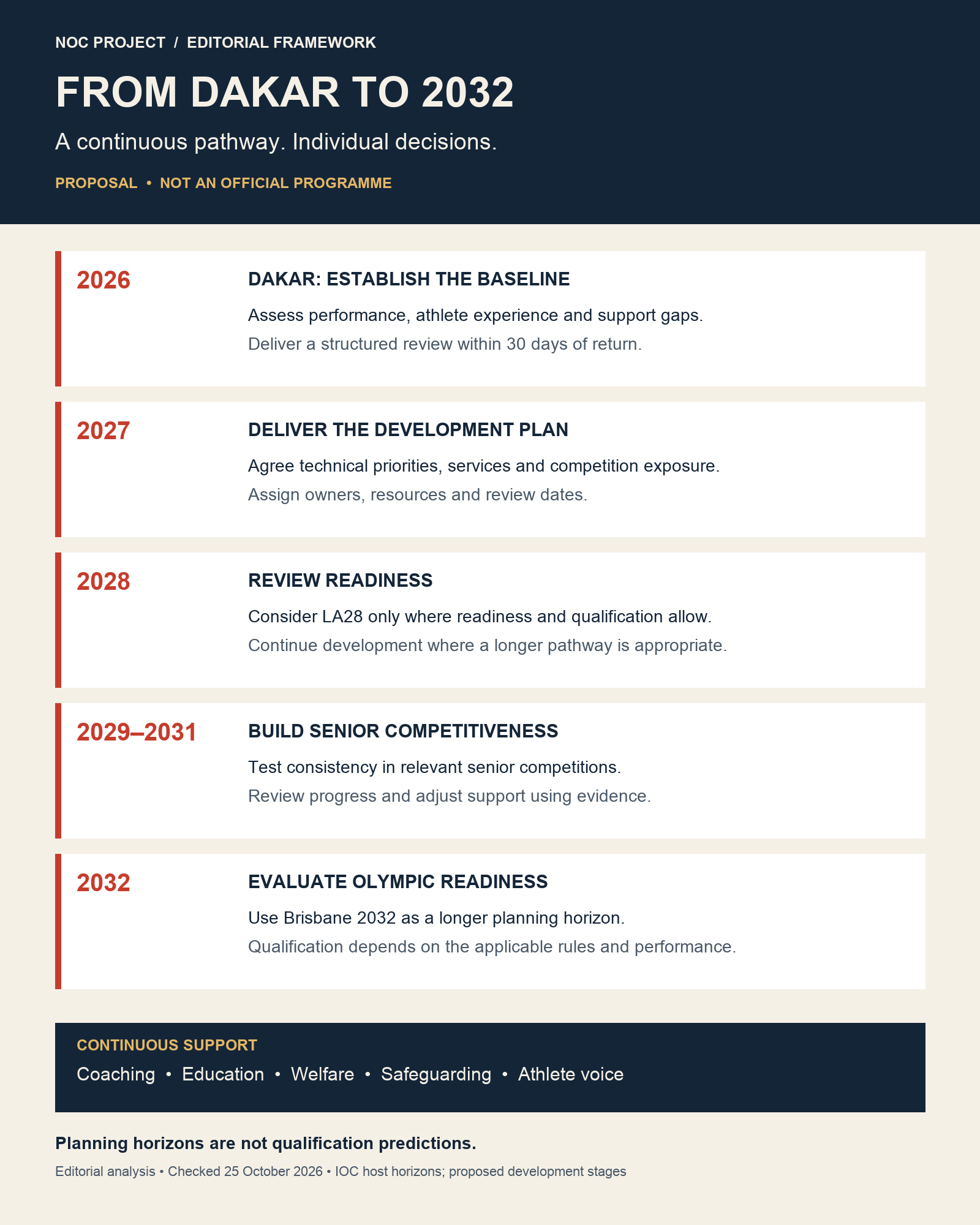
A proposed 2026–2032 framework, with LA28 considered individually and Brisbane 2032 as a longer planning horizon. Editorial proposal, not an official programme.
Give the pathway an accountable operating structure
The federation should lead sport-specific coaching and competition planning. An agreed NOC coordination role could connect international Games preparation, cross-sport services and periodic pathway reviews. These are proposed responsibilities that would need agreement, resources and a named owner.
A workable review should bring the athlete’s perspective into the same discussion as the performance evidence. Coaches should explain the intervention; the federation should confirm delivery; the coordinating body should identify unresolved barriers and record the next decision.
Each sport should also produce a development-gap report. If the same technical weakness appears repeatedly, the response may require coach development or better competition exposure. If progress stalls because specialist services arrive late, the remedy is an operational change. An athlete report should therefore inform a wider improvement plan.
Protect continuity, education and athlete voice
Young athletes need a clear route to raise concerns independently of their immediate coaching relationship. Travel arrangements, accommodation, digital communication and use of images should follow an agreed youth safeguarding standard, with responsibilities explained in language athletes understand.
The pathway should also make room for education, recovery, changing ambitions and an eventual transition out of elite sport. These are design requirements for the proposed programme. They should be resourced and reviewed alongside performance services.
Sensitive welfare information must remain separate from public reporting. A public progress report can describe support delivery and aggregate outcomes without exposing personal health information or identifiable safeguarding cases.
Measure whether the experience changed the trajectory
A broader scorecard can retain competition results while adding evidence of development. Track the performance gap against a defined benchmark, delivery of agreed support, continuity in the pathway and the athlete’s experience of the programme.
Use these measures carefully. Retention alone does not prove that a programme works, and departure is not automatically failure. A reported concern may indicate that an athlete trusts the reporting channel. Each measure needs interpretation, a responsible reviewer and a documented response.
The first implementation window should be concrete: a debrief within 30 days of return, an agreed plan within 60 days, and confirmation of delivery responsibilities and resources within 90 days. These are proposed management deadlines, not existing NOC commitments.
Dakar can give Indonesia an international reference point. The lasting benefit will come from the decisions that follow: better targeted support, stronger federation practice and a development system that remains accountable to the athlete through 2032 and beyond.