What Indonesia’s 2026 incidents reveal about safeguarding and the duty of care

AI-assisted editorial illustration with fictional people; not a reconstruction of an incident.
Athlete safety must become a condition for holding a competition. Every organiser should be able to show who can stop an event, who responds to a medical emergency, and who follows an injured athlete through referral and recovery. A policy becomes useful when those responsibilities work under pressure.
The deaths of Syabilla Rizkia Putri Raharja and Ayudiah Rivana Tridiandinita during the Central Java Porprov period demand that standard. So does the separate head-impact incident reported at the same event. I share the concern of Krisna Bayu, a former judo Olympian and Executive Committee Member of the Indonesian Olympic Committee (NOC Indonesia), that various working commissions of NOC Indonesia should provide practical recommendations. The task now is to turn that concern into decisions, resources and verification. [1, 2, 3]
Different incidents require different investigations
Syabilla died on 25 October 2026 during the 3,000-metre open-water finswimming event at Awann Costa, Semarang. The ministry reported that POSSI had formed an investigation team. On 2 November, police told detikJateng that ten witnesses had been examined and possible negligence remained under investigation. Those reports justify scrutiny of surveillance and rescue readiness; they do not establish the medical cause or prove who failed. [2,4]
Ayudiah suffered a finger injury on 26 October, underwent surgery the following day and died in hospital on 28 October. KONI Central Java published the hospital director’s account that she had been conscious after surgery and that the cause of death remained undetermined. Describing this as a death caused by a finger operation would go beyond the evidence. The clinical investigation must examine the complete course of care, including observation and escalation, without assuming a diagnosis. [3]
KONI also confirmed a separate pencak silat athlete experienced seizures following head impact and was subsequently reported to be improving. This is a different mechanism again. A video may show a fall and visible distress. It cannot measure mat performance, establish an intracranial diagnosis, or reconstruct every clinical decision. [1]
The 2026 pattern extends beyond one competition
On 20 September, football player Ahid Ali Hasbi collapsed without reported contact during a Tasikmalaya tournament and died after emergency treatment. The organiser’s explanation about fatigue was not a confirmed medical diagnosis. This case broadens the preparedness question to sudden medical emergencies in field sports. [5]
RRI reported in June that boxer Ikhwan, then preparing in a training-centre environment in Lampung, suffered an alleged assault. The report is an allegation requiring proper investigation, but its relevance is clear: protection must include security and violence around training environments, as well as conduct inside sport. [6]
There is also a boundary worth recognising. Unggul FC reported that goalkeeper Azfar Burhan died in a road accident on 10 February while travelling back towards his club’s departure arrangements. That is not an on-field fatality or evidence of organisational negligence. It does raise a separate question about the scope of organised travel, safe scheduling and responsibility for journeys that clubs arrange or control. [7]
Climbing and kickboxing allegations reported in 2026 add the direct safeguarding dimension of possible sexual violence and abuse of power. The ministry reported in August that a former climbing head coach had been named a suspect and the case transferred to prosecutors; that is not a conviction. Moreover, events allegedly occurring in earlier years must not be counted as new 2026 assaults merely because they were reported in 2026. [8, 9]
These examples form a selected case review, not a national injury register. They cannot establish that one sport is more dangerous than another. That comparison requires participation and exposure data, consistent definitions and verified outcomes. Said Alif’s death in February 2025 is a relevant historical warning, but it belongs outside a 2026 incident count. [16]
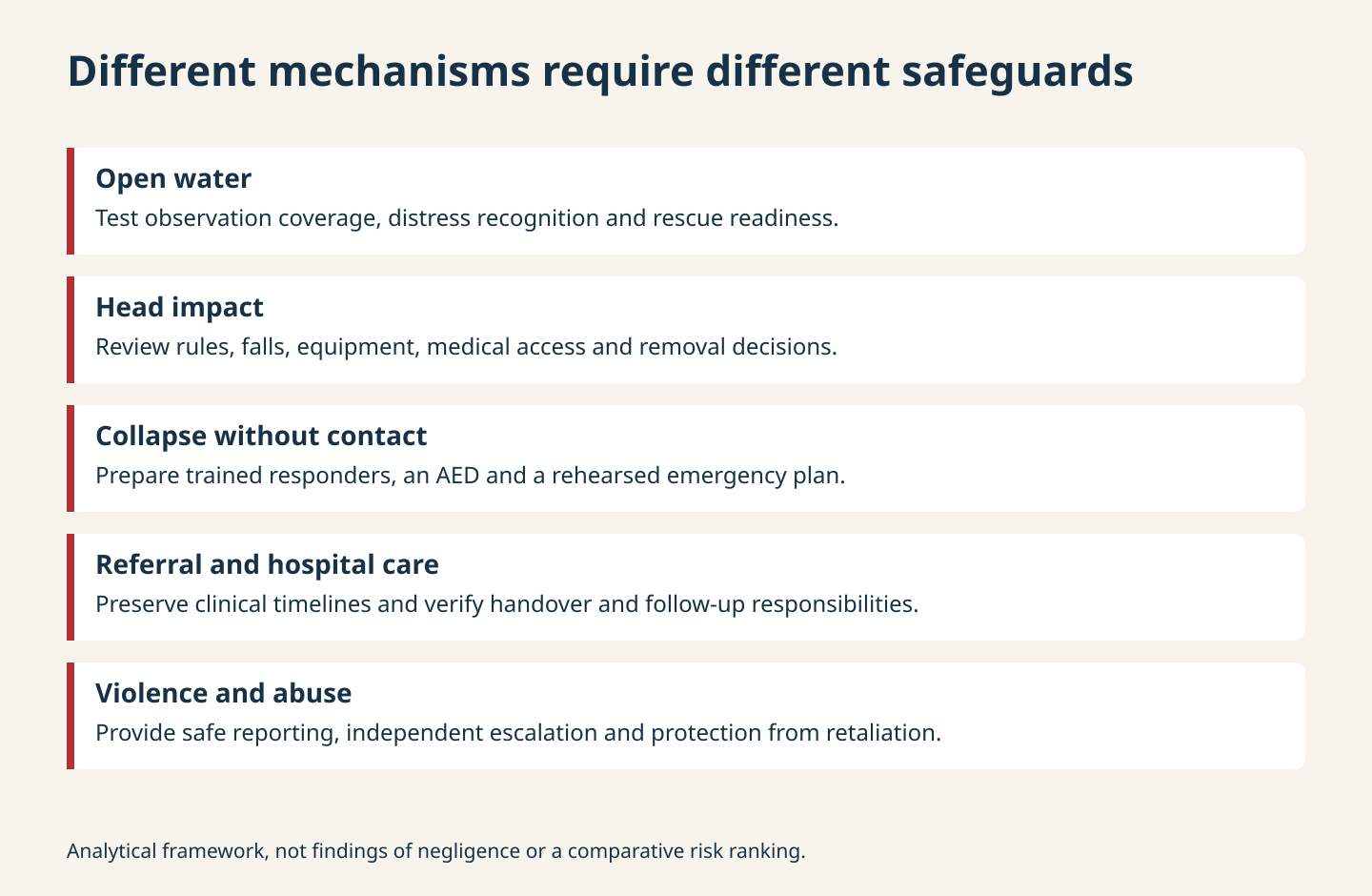
Analytical risk pathways; no ranking or cause of death is inferred.
Where safeguarding contributes
The starting distinction matters. Medical safety addresses injury prevention, rescue and treatment. Safeguarding addresses harassment, abuse, exploitation and neglect, including the organisational conditions that allow harm to persist. The IOC’s 2024 consensus emphasises a whole-system approach to interpersonal violence and athlete-centred care. Bringing the two functions together strengthens protection while retaining the specialist judgement each requires. [10, 11]
A recognised sporting risk does not automatically constitute abuse. The safeguarding connection becomes material when someone ignores a known danger, pressures an athlete to continue, obstructs care, withholds necessary support, or threatens a person who reports a concern. Whether any of those occurred in a particular case must be established through evidence.
The usual five categories are psychological abuse, physical abuse, sexual harassment, sexual abuse and neglect. Online abuse describes a setting or mode through which several forms can occur. Safeguarding also extends beyond athletes: coaches, medical staff, officials and volunteers can be affected or hold duties. A welfare officer should make reporting and protection accessible, while competent clinicians and technical officials retain responsibility for their professional decisions.
There is no clean transfer of all responsibility to the IOC or OCA during Games time, or to an NOC outside it. Games frameworks supplement other rules and legal duties. In a domestic Porprov, the organiser, relevant federations, KONI bodies, medical providers and public authorities have distinct responsibilities. NOC Indonesia can convene, educate and promote common standards; its authority to direct, discipline or sanction must be grounded in applicable rules. A safeguarding officer cannot simply impose a worldwide lifetime ban. [10]
The shared weakness to examine is the chain of protection
The common issue is the chain linking risk assessment, recognition, intervention, referral and follow-up. A failure at any point can undermine the rest. The cases do not prove that this entire chain failed; they identify where investigators and organisers should test it.
For open water, reconstruct the course risk assessment, conditions, observation coverage, participant tracking, distress recognition, rescue deployment and hospital transfer. For throws and falls, examine the permitted technique, age and skill matching, breakfall competence, head and neck position, mat system, referee decisions and medical access. These are competing or interacting factors to investigate, not a conclusion that the mat caused an injury.
Mat thickness alone cannot establish protection. Regulation 15 of 2022 includes a five-centimetre professional pencak silat mat specification in its PPLP equipment standards. Its legal scope must be respected rather than treated as a universal finding about every tournament. An engineering review should examine impact attenuation, installation, joints, substrate, wear and the applicable competition rules. Breakfall training deserves attention, but responsibility must not be shifted onto injured athletes. [15]
For collapse without contact, the concern is immediate recognition and a rehearsed response. FIFA recommends an emergency action plan, trained responders and access to an automated external defibrillator. For suspected concussion, CDC guidance calls for immediate removal, no return on the day of injury and medical clearance. Seizures following head impact require emergency medical assessment. These principles should be translated into sport-specific clinical protocols, not improvised at the edge of the arena. [12, 13, 14]
Make readiness a requirement before the event starts
I propose a joint safety and safeguarding readiness decision before each competition or training camp. The organiser should produce a risk assessment, a named medical lead, a safeguarding focal point, a rescue and referral plan, working communication arrangements and funded emergency care. The practical question is whether a drill shows that people and equipment can reach the athlete promptly.
Authority must be explicit. Medical staff should be able to remove an athlete on clinical grounds. Technical officials should stop unsafe competition. Organisers must know when missing coverage, deteriorating conditions or equipment defects require postponement. If the only ambulance departs with a patient, equivalent emergency cover must be restored before activity dependent on that cover resumes. These are proposed operating requirements, to be formalised by competent bodies.
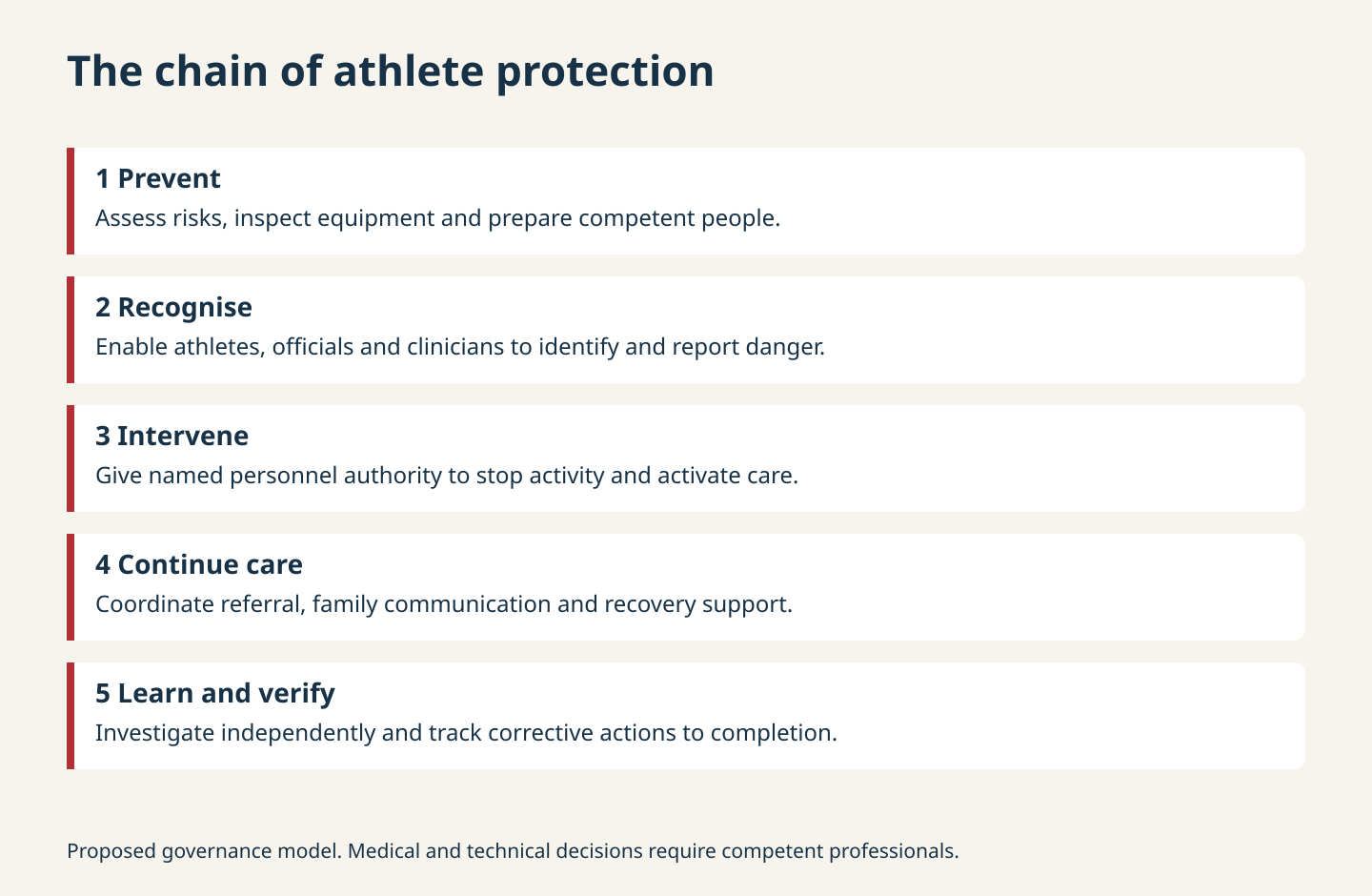
Proposed model connecting safeguarding with medical and technical safety.
Give every commission a deliverable
The Medical Commission should lead clinical standards and emergency preparedness. Technical Experts and Federations should own sport rules, venue and equipment controls. The Safeguarding Taskforce should provide confidential reporting, independent escalation, support coordination and protection from retaliation. The Athletes’ Commission should test whether athletes understand and trust the system. Legal and governance specialists should map authority, privacy, insurance and fair process.
A serious incident should trigger immediate protection and evidence preservation, followed by an independent review proportionate to the event. Preserve original video, inspection records, staff rosters, communications and clinical timelines through lawful access. Separate the learning review from disciplinary, police and clinical proceedings, and coordinate them so one does not compromise another. Inform families through a designated liaison and publish findings that can responsibly be disclosed.
Krisna Bayu’s proposal for stronger presidential-level coordination may merit policy discussion, but a new position is not a substitute for clear operational ownership. Existing institutions can begin by assigning each corrective action an owner, deadline and evidence of completion. [17]
Measure whether protection actually works
Within 30 days, I would ask organisers and federations to map high-risk activities, confirm stop authority and audit emergency coverage. By 60 days, priority venues should complete joint drills and test reporting channels with athletes. By 90 days, the responsible governing bodies should review an anonymised incident register, verify corrective actions and report unresolved risks. These are proposed targets, not IOC deadlines.
The register should distinguish deaths, serious injuries, medical emergencies, allegations of abuse and near misses. Record athlete exposure where feasible, so future comparisons can use rates rather than raw headlines. Track rescue and treatment milestones, drill performance, complaints of retaliation and overdue actions. Keep identifiable medical details private; publish aggregated learning and correction status.
I would judge progress by whether an athlete can stop when something feels wrong, whether a clinician can intervene without pressure, and whether a warning produces action before another person is harmed. Safeguarding contributes by making those decisions possible and accountable. Our duty is to build a system in which athletes can pursue success with protection they can rely on.