Technology and the Next Transformation of Indonesian Industry
Indonesia's next industrial transformation will come from combining data, automation, AI and skilled people to redesign how value is created.
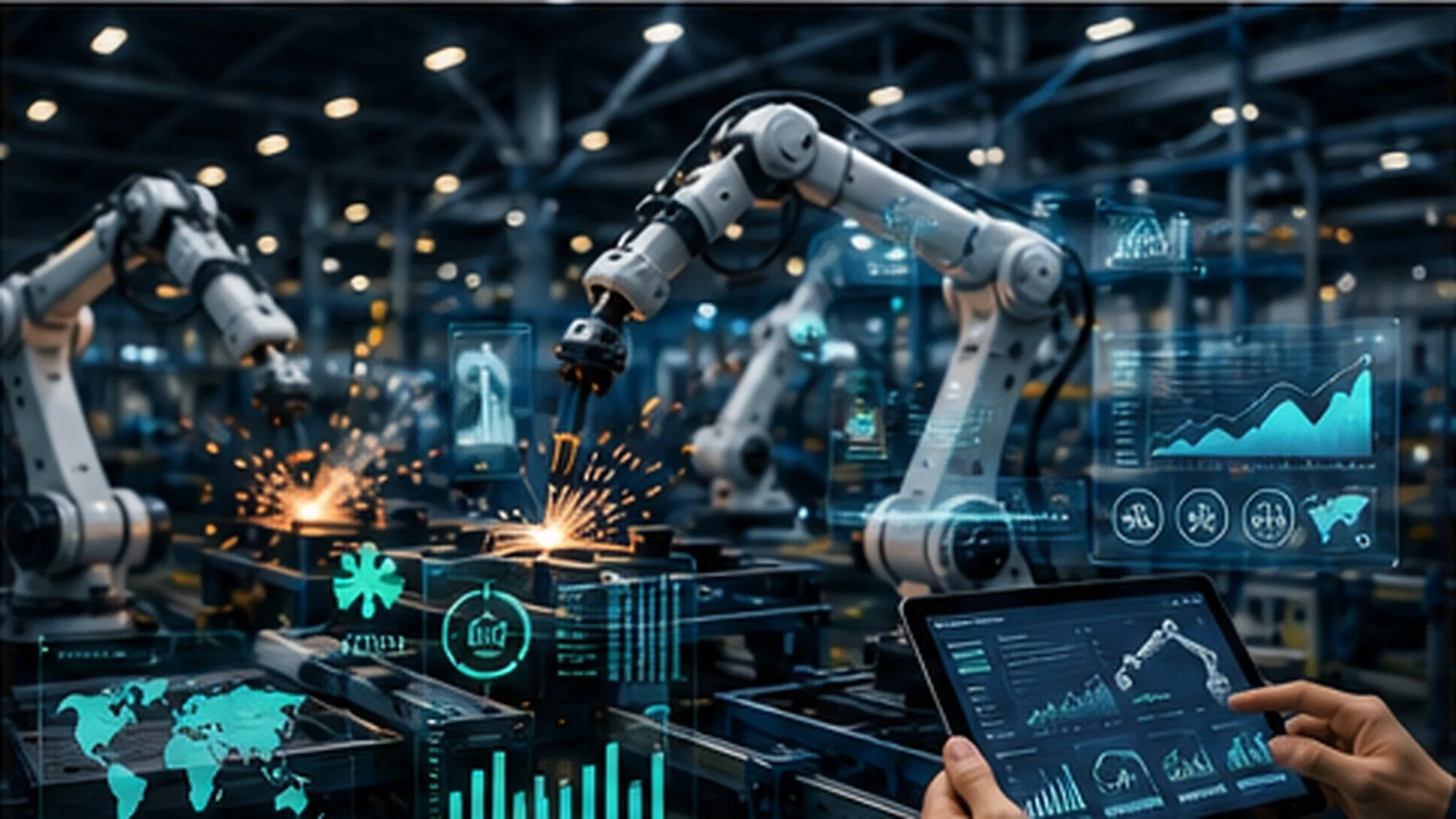
Indonesian engineer supervising robotic manufacturing systems in an advanced factory
The first wave of industrial digitalization was largely about automation: replacing repetitive manual tasks, installing programmable controls and connecting equipment to basic monitoring systems.
The next transformation will be different. It will be about intelligence.
Sensors, cloud platforms, artificial intelligence, machine vision, advanced robotics and digital engineering are beginning to change not only how products are manufactured, but how demand is forecast, factories are scheduled, quality is controlled, energy is consumed, suppliers are coordinated and customers are served.
This shift matters deeply for Indonesia. Manufacturing has remained the country's largest contributor to gross domestic product, according to BPS, and it supports broad networks of workers, suppliers, logistics providers and regional economies. Improving industrial productivity is therefore not a narrow factory issue. It is central to national competitiveness, job quality and economic resilience.
The opportunity is substantial, but the central lesson is simple:
“Technology becomes an industrial advantage only when it changes decisions, processes and economics.”
Buying software is not transformation. Installing robots is not transformation. Running a pilot is not transformation. The outcome depends on whether technology improves the operating system of the business.
From automated machines to intelligent operations
Traditional automation follows predefined rules. Intelligent operations combine four capabilities:
They sense. Equipment, products and processes generate real-time data through sensors, cameras, control systems and connected devices.
They understand. Analytics and AI identify patterns, predict failures, detect anomalies and compare actual performance with expected performance.
They decide. Planning systems recommend schedules, maintenance actions, quality interventions, inventory changes or energy adjustments.
They improve. Feedback from operations is used to refine models, processes and standards over time.
The progression is not from people to machines. It is from fragmented decisions to better coordinated decisions, with people and technology each performing the work they do best.
A technician supported by predictive diagnostics can prevent a failure before it stops production. A quality engineer using machine vision can inspect more consistently while focusing human attention on complex exceptions. A planner with better demand and inventory data can reduce working capital without weakening service.
The real value lies in the system, not the device.
Six areas where value can be created
Industrial transformation becomes credible when it is connected to measurable operational outcomes. Six areas deserve particular attention.
1. Planning and scheduling
Many factories still plan using disconnected spreadsheets, delayed reports and informal coordination. AI-assisted planning can combine orders, capacity, material availability, changeover time and delivery commitments to produce more realistic schedules.
The benefit is not theoretical optimization. It is fewer delays, better utilization, lower work-in-progress and improved customer reliability.
2. Quality and yield
Machine vision can identify defects that are difficult to detect consistently at speed. Statistical models can identify process conditions associated with quality variation. Digital traceability can connect finished products to materials, machines, operators and production conditions.
The goal is to move from inspecting quality at the end to controlling quality throughout the process.
3. Predictive maintenance
Maintenance is often either reactive - repairing equipment after failure - or overly preventive, replacing components according to fixed intervals whether necessary or not.
Condition monitoring and predictive analytics can help maintenance teams intervene at the right time. The economic impact may include higher uptime, lower spare-parts cost, safer operations and longer asset life.
4. Energy and material efficiency
Energy, water, raw materials and scrap directly affect margins. Connected meters and process analytics can expose losses that are hidden in monthly reports.
AI can help optimize energy-intensive equipment, detect leaks, reduce off-spec production and sequence operations around demand and tariff conditions. This is where industrial productivity and sustainability often reinforce each other.
5. Supply-chain resilience
Industrial performance depends on events outside the factory: supplier delays, logistics constraints, commodity movements, weather, demand volatility and geopolitical disruption.
Better data and scenario modelling can improve supplier risk monitoring, inventory positioning, logistics planning and response speed. The objective is not maximum inventory or minimum inventory. It is the right resilience for the economics and risk profile of the business.
6. Service and product innovation
Connected products can generate new service models. Digital configuration can shorten product-development cycles. Customer data can reveal unmet demand and improve after-sales support.
For some companies, the largest long-term value will not come from producing the same product more efficiently, but from changing the offer itself.
Why industrial technology programs stall
The barriers are rarely caused by a complete absence of technology. More often, transformation stalls because the business system is not ready to use it.
The project begins with a tool instead of a problem
A company buys an AI platform, robot or dashboard because the technology appears modern. The team then searches for a use case. This reverses the correct sequence.
The starting point should be an operational problem with a baseline: unplanned downtime, high scrap, late delivery, excessive energy use, unstable quality or working-capital pressure.
Pilots remain isolated
A successful demonstration on one line can fail to scale because data definitions, equipment interfaces, cybersecurity requirements and ownership differ elsewhere.
The pilot should be designed from the beginning with repeatability in mind. Otherwise, the organization collects demonstrations rather than capabilities.
Data is fragmented or unreliable
AI cannot compensate for inconsistent master data, missing sensors, manual workarounds and unclear process ownership.
Data quality is not an IT housekeeping task. It is part of operational discipline.
Processes are not redesigned
Adding a dashboard does not create value if nobody changes a decision. Predictive maintenance does not help if spare parts, work permits and technician schedules cannot respond. A planning model is useless if commercial teams continue to override it without accountability.
Technology and process redesign must move together.
Employees are treated as obstacles
Transformation fails when people believe technology is being imposed without understanding, preparation or respect for operational knowledge.
Frontline employees often know where the real constraints are. They should participate in designing solutions, testing assumptions and defining practical workflows.
Cybersecurity is added too late
Connecting operational technology creates new exposure. Factory networks, remote access, cloud integration and vendor support must be secured from the design stage.
A cyber incident can create production, safety and reputational consequences far beyond the IT department.
Economics are never made explicit
Technology programs need a business case that includes implementation cost, integration, training, maintenance, recurring subscriptions, downtime risk and organizational change.
The correct question is not whether a technology is impressive. It is whether the full investment produces a durable improvement in cash flow, risk or strategic capability.
Indonesia's particular opportunity
Indonesia has a diverse industrial base: large multinational plants, national champions, state-owned enterprises, mid-sized manufacturers and extensive networks of small suppliers.
A single transformation model will not fit all of them.
Large companies may be able to build advanced data platforms and dedicated AI teams. Smaller firms may benefit more from modular cloud services, shared engineering support, standardized automation packages and sector-level platforms.
This makes interoperability important. Industrial systems should not trap companies inside one vendor's architecture. Open interfaces and portable data reduce long-term dependency and make it easier for local suppliers to participate.
Indonesia also has the opportunity to combine technology adoption with domestic capability-building. Every investment in automation creates demand for system integrators, software developers, electrical engineers, machine builders, cybersecurity specialists, maintenance technicians and vocational training.
If these capabilities are developed locally, industrial digitalization can create jobs as well as productivity.
The five enablers of transformation
Technology creates results when five enabling conditions are present.
Leadership with operational ownership
Industrial transformation cannot be delegated entirely to IT or innovation teams. Plant, operations, finance, commercial and human-resources leaders must share accountability.
Each use case should have a business owner, a technical owner and a financial outcome.
A coherent data foundation
Companies need common definitions for products, equipment, customers, suppliers, quality and performance. Data architecture should connect operational technology with enterprise systems without forcing every legacy system to be replaced immediately.
A practical architecture is more valuable than a perfect architecture that takes years to deliver.
Interoperable technology
Factories usually contain equipment from many generations and vendors. The goal should be to create a controlled integration layer that allows data and workflows to move across systems.
This reduces duplication and makes future investments more flexible.
People and capability
Komdigi has projected that Indonesia will require digital talent at a scale measured in millions by 2030. Industry needs more than software developers. It needs hybrid professionals who understand both technology and operations: data-literate production leaders, automation technicians, industrial cybersecurity specialists and engineers who can translate business problems into working systems.
Capital and patience
Transformation is a journey, not a single procurement. Some use cases pay back quickly; others build foundational capability.
Management must balance short-term returns with the long-term need to modernize data, equipment and skills.
A practical 24-month industrial playbook
Companies do not need to transform everything at once. A disciplined sequence reduces risk.
First 90 days: establish the baseline
Identify the three to five largest operational losses.
Quantify downtime, scrap, energy, inventory, delay and quality variation.
Map the relevant data and systems.
Assess cyber and workforce readiness.
Select one or two use cases with clear owners and measurable economics.
Months 3-9: prove the operating model
Build the minimum data and integration needed.
Run the use case in live operations, not only in a laboratory.
Train employees and redesign the decision process.
Measure results against the original baseline.
Document what would be required to repeat the solution.
Months 9-18: scale the reusable components
Standardize data definitions, interfaces and cybersecurity controls.
Expand successful use cases to additional lines, plants or functions.
Create an internal product team rather than a sequence of temporary projects.
Negotiate technology contracts around portability and performance.
Months 18-24: connect the value chain
Extend selected capabilities to suppliers, logistics partners and customers.
Use shared data for planning, traceability and risk management.
Develop new services or product features enabled by connected operations.
Review whether organizational structures and incentives still support the new system.
The role of industry institutions
Indonesia already has a policy foundation through Making Indonesia 4.0 and programs such as PIDI 4.0. The next step is to make the ecosystem more accessible and outcome-oriented.
Shared demonstration facilities can help companies test technologies before committing major capital. Sector-specific reference architectures can reduce duplication. Vocational institutions can train technicians on real industrial systems. Financing programs can support projects with measurable productivity outcomes.
Industry associations can also help establish common data, cybersecurity and interoperability standards. This is particularly important for supplier networks, where one large company's requirements can otherwise create disproportionate cost for smaller firms.
People remain the force multiplier
The most productive industrial systems will not be the ones with the fewest people. They will be the ones where people can make better decisions, solve problems faster and focus on work that requires judgment, creativity and responsibility.
Some tasks will disappear. New tasks will emerge. Most roles will change.
The responsible approach is not to deny this transition or to present it as automatic progress. Companies should identify the skills affected, redesign roles, provide credible training and share productivity gains through stronger businesses, safer work and better career paths.
A factory becomes intelligent when its people and systems learn together.
The competitive question
Indonesia's industrial future will not be determined by whether factories own robots or use AI terminology. It will be determined by whether companies can consistently translate technology into:
higher productivity;
better quality;
lower energy and material intensity;
faster innovation;
more resilient supply chains;
stronger local suppliers; and
a workforce capable of continuous improvement.
Technology is a force multiplier. It magnifies the quality of management, processes, data and skills already present.
That is why the next industrial transformation is not mainly a technology project. It is a business transformation - enabled by technology, disciplined by economics and sustained by people.
Related insights
Indonesia's Green AI Opportunity: Building the Infrastructure Behind the Intelligence
From Digital Infrastructure to Industrial Capability: What Indonesia Should Build Next